

Right–Wrong vs. Good–Bad
We often assume that what is Right is also Good, and what is Wrong is also Bad. That shortcut confuses rule-following with value creation—and lies at the root of many of our problems.
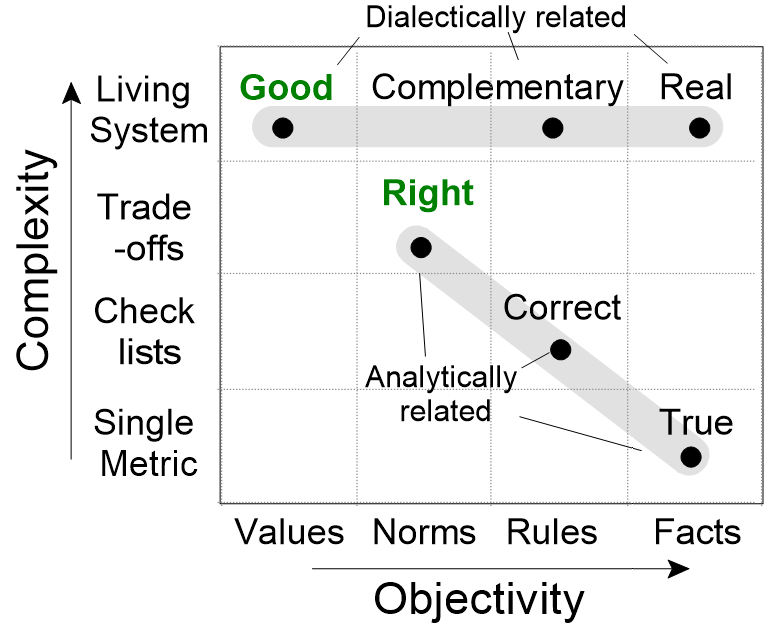
Right usually means fits a norm or rule. Good, on the other hand, asks whether an action helps the complementary parts of a living, multi-factor system thrive.
When we confuse the two, we try to govern complex reality with primitive rules. That’s how we fool ourselves—and how others fool us. In theory, there’s no difference between theory and practice; in practice, there is. A rulebook can be perfectly consistent and still a poor fit for the world.
Dialectically, Norms and Rules are good only insofar as they complement our ability to learn and grow. Likewise, any technology is only good as long as it complements the versatility and sustainability we had before it. Otherwise, it turns Bad. (See Redefining Good and Bad)
In general: Right becomes Bad when it neglects the positive side of being Wrong—humility, curiosity, and the capacity to grow. Wrong becomes Good when it acknowledges the positive side of being Right—clarity and simplicity.
Therefore:
Embrace the Wrong to find the Right, and avoid the Right who avoids the Wrong.
When we ignore this balance, we create a hell—a world where everyone is “Right,” but nothing is Good.

“So where is justice?” — asked the granddaughter.
“In hell,” — replied the grandmother.
“And what is in heaven?” — the girl wondered.
“In heaven,” — the grandmother smiled, “there is love.”
This dialectic even shows up in arithmetic.
Mathematically, 1 + 1 = 2 is Right because it follows the rule. But in real life, 1 + 1 = 2 can be Bad, because it implies no synergy—no collaboration. In a team, 1 + 1 > 2; otherwise, we add without creating.
So what looks Wrong or False on a narrow metric can be Good in a living system.
Mom + Dad = Family > 2 — that’s happiness in life, but it looks “Wrong” to a bureaucratic mindset.
This reveals the essence of Bureaucracy—perhaps the most dangerous phenomenon in society.
For bureaucrats, breaking a rule is always Wrong; for normal people, it is often Good.
Being Right is often more profitable than being Good — but ask yourself:
Is it really better?