

From quasi-stability to synthesis—or imitation
Compromise is a pause, not a destination. Given enough time, it turns into either a true synthesis or a false imitation:
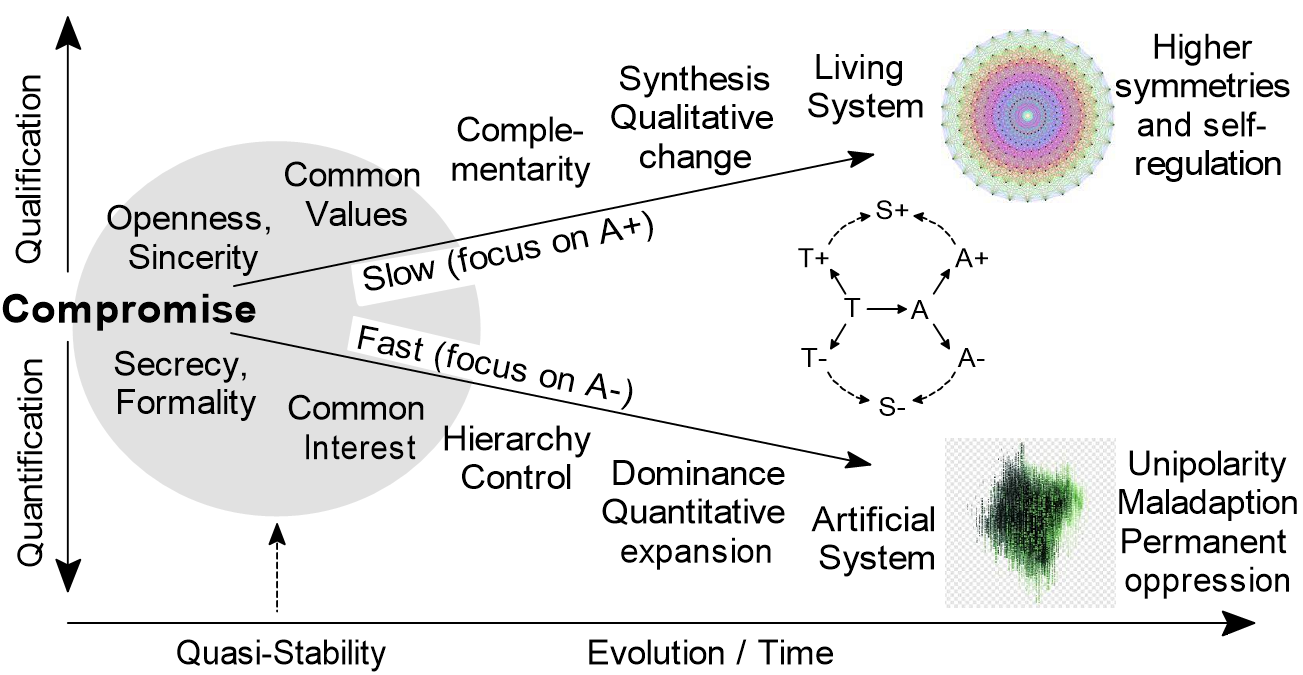
1️⃣ Grey Zone — Quasi-Stability
We often get trapped in a grey zone of endless maneuvering between openness and secrecy, values and interests. We call it stability, but it lasts only as long as external supplies flow. Once they dry up, the illusion breaks. True synthesis doesn’t collapse so easily: living systems can fast without dying, while false equilibrium starves to death. Remove material support, and you’ll see who remains a true partner and who was merely feeding on the surplus.
2️⃣ The path of qualification — toward synthesis
When both sides stay open and sincere, they search for common values, not just common interests. Differences become complementary, and the system evolves to a higher level — a qualitative change. This is the path of living systems: diversity that learns to self-regulate and thrive. See Artificial Intelligence vs. Articifial Ignorance for further explanations.
3️⃣ The path of quantification — toward imitation
When each side clings to formality and secrecy, compromise becomes a cover for control. Hierarchy replaces trust; success shrinks to metrics and compliance. The system expands but does not evolve—an artificial order that hardens into oppression (see Young’s Maladaptive Schemas or Orwell’s 1984). From there, it can split into disintegration (parties disengage) or self-extermination (Calhoun’s behavioral sink).
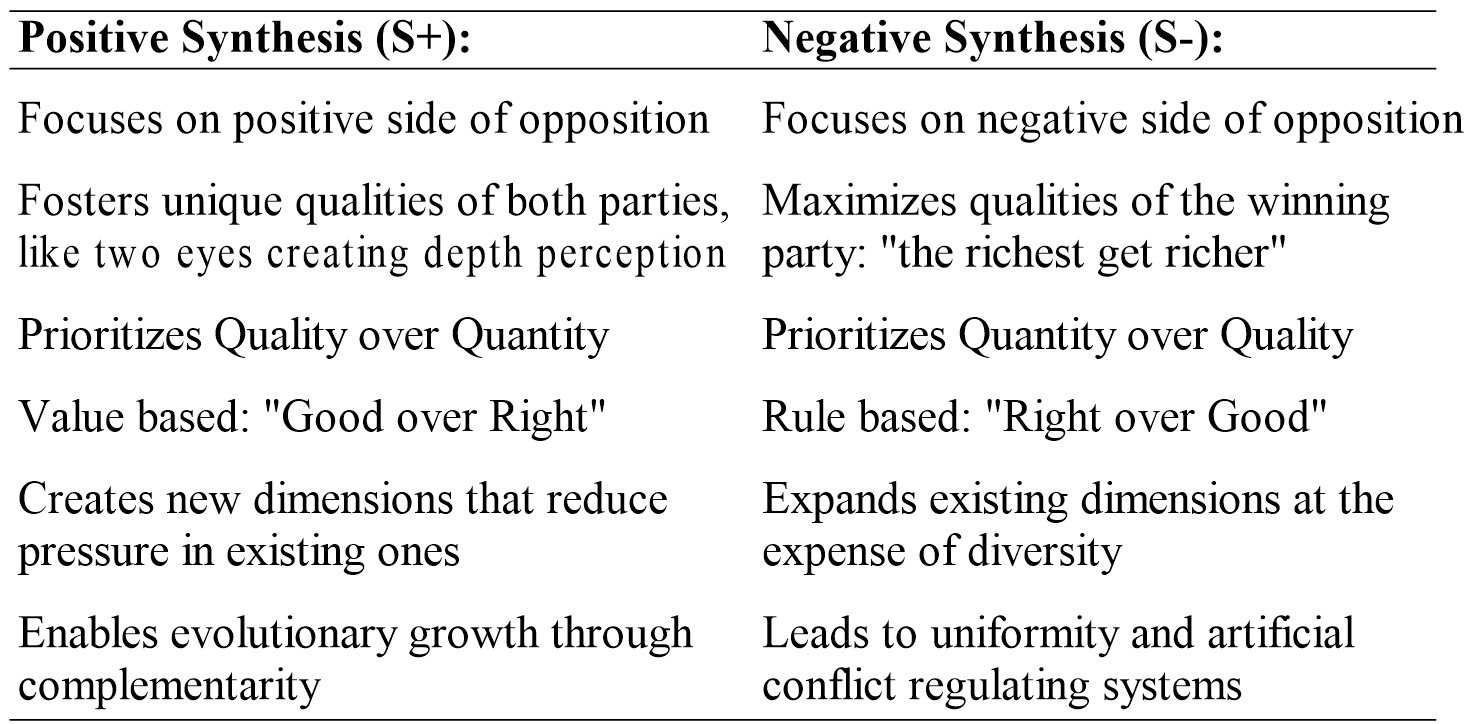
The moralization trap
The simplest diagnostic of a failing compromise is moralization — endless talk about who is right and who is wrong (see When Right is Bad and Wrong is Good)
In balanced systems, thesis and antithesis exist like organs of one body. When one hurts, we don’t moralize — we heal. Treat your counterpart the same way: as part of a single organism.
Instead of defending your “rightness,” explore what you can learn from their “A⁺” — the quality they embody that is contrary to your own absolutization.
Don’t ask who is right. Ask what can we become together that neither of us can be alone.
What to do when compromises fail
- Switch the goal.
Stop trying to “meet halfway.” Instead, design a third option that improves the system itself.
The question is not who wins, but what evolves. - Prototype complementarity.
Run small experiments where both sides win only if the whole system wins. Use Eye Opener to model possible scenarios - Iterate.
Treat agreements as living hypotheses, not final peace treaties. See Breaking False Certainty
Further Reading on the Art of Compromise
Family & Relationships
- The Art of Compromise – The Gottman Institute
- How to Master the Art of Compromise in Your Relationship – Psychology Today
- How to Fight Without Hurting Your Relationship– Greater Good Science Center
Business & Negotiation
- Principled Negotiation: Focus on Interests, Create Value – Harvard PON
- Summary of Getting to Yes – Beyond Intractability
- Mutual Gains Approach (Wikipedia Overview)
Politics & Governance
- The Spirit of Compromise – Gutmann & Thompson (Book Summary)
- Conversation on “The Spirit of Compromise” – University of Pennsylvania