

The Binary Thinking Trap
“Those who believe they are certainly right are certainly wrong.” ~ Ian McGilchrist
Certainty is the vital force that constructs reality. But when stripped of Humility and Doubt, it undergoes an Inside-Out Perversion that destroys individuals, organizations, and societies:
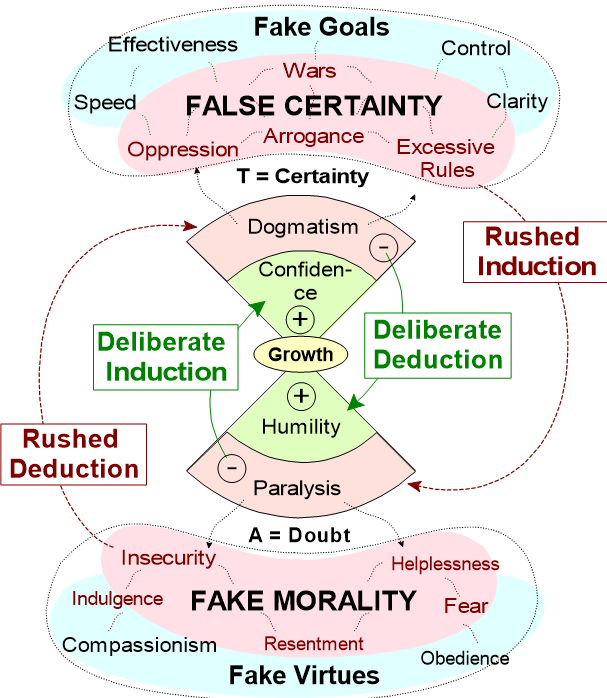
The False Certainty (Top Inversion): Driven by “rushed deduction,” logic degenerates into dogmatic tyranny—where abstract maps override physical reality, and structural violence is rebranded as efficiency.
The Fake Morality (Bottom Perversion): Driven by “rushed induction,” localized anxiety is generalized into Orwellian dogma—where learned helplessness is rebranded as compliance, indulgence as compassionism, and intolerance as a fight for safety.
This cycle can only be broken through two deliberate and synchronized movements that act as a centripetal force, pulling the system back to the center of the Growth Spiral:
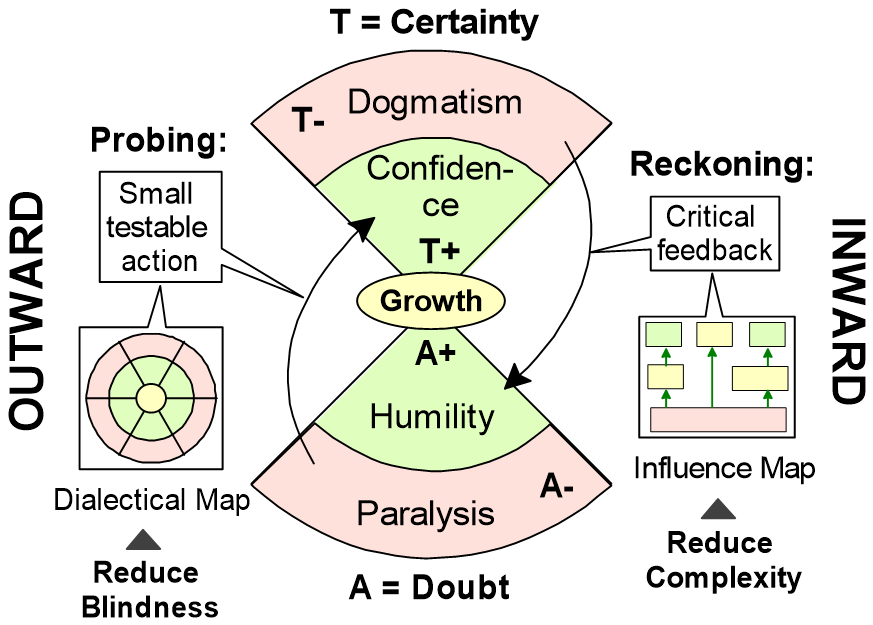
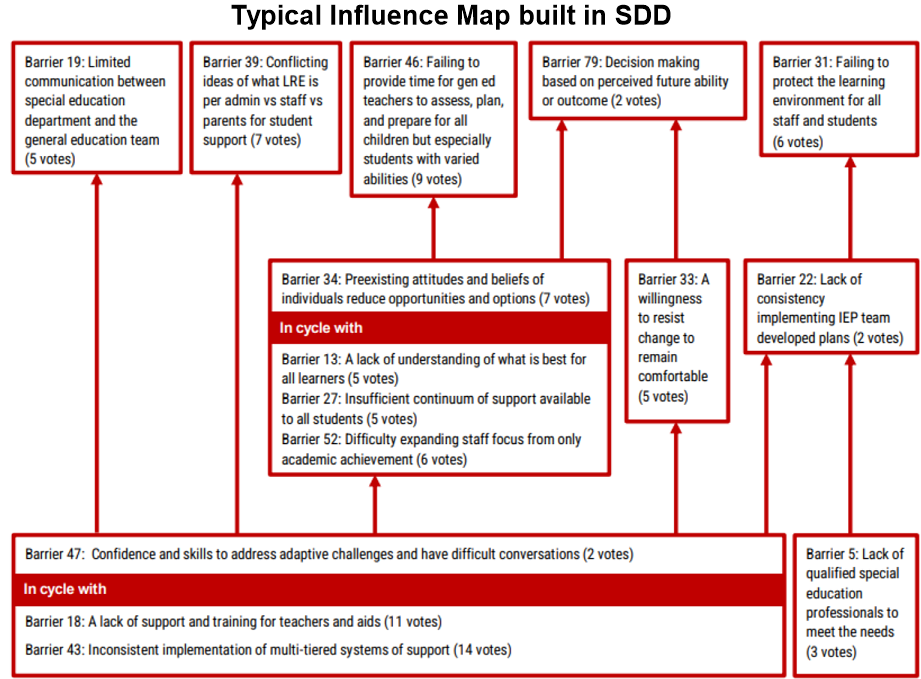
The Inward Movement (Dogmatism → Humility): Reckoning with reality by seeking honest, external feedback, facilitated by Cognitive Reconstructuring. To accelerate the process, inner concepts can be arranged into Influence Maps that are typically used in SDD, but can also be applied to restructuring our inner dialogue. By arranging concepts into hierarchies, it turns conflict into a collaborative deduction of why a system fails.
The Outward Movement (Paralysis → Confidence): Probing reality using small, testable steps and adapting to the results, facilitated by Behavioral Activation. To accelerate the process, use Dialectical Wheels via the Eye Opener app to map the hidden upsides and downsides of both our core beliefs (theses) and what we actively disregard (antitheses). This identifies blind spots and suggests how to transform innate exaggerations into constructive synthesis.
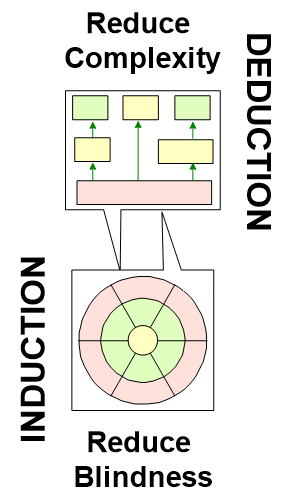
These frameworks are deeply complimentary, since SDD reduces systemic complexity via structured deduction, while Dialectics expands systemic vision via structured induction. Together, they can break the cycle of self-deception at both personal and organizational levels.
Yet, because mainstream arenas habitually default to binary, adversarial debate, these frameworks remain poorly recognized (Flanagan & Christakis, 2010).
See also: Combatting false Certainty in Business
Institutional and Ideological Oppression
The above frameworks remain powerless against a deeper adversary: the entrenched ideological and institutional conviction in the absolute supremacy of Formal Logic over Humility and our broader senses:
“If you follow formal logic to its ultimate conclusion in human affairs, you end up with perfectly organized madness.” — George Orwell
Formal logic only holds true in one-dimensional cases where 1 + 1 = 2, i.e. when both components lay on a single line:
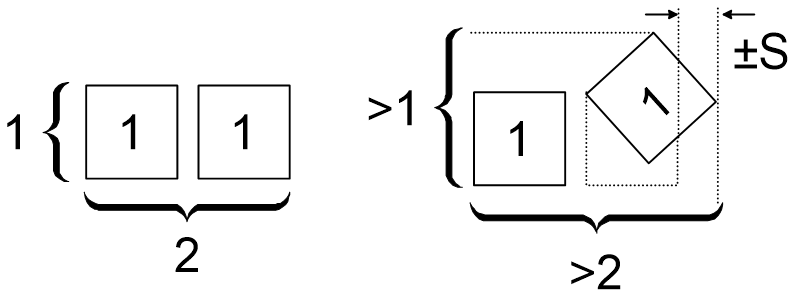
In real systems, however, variables occupy non-parallel dimensions, yielding synthesis where 1 + 1 > 2 and the whole exceeds the sum of its parts. This is where formal logic breaks—a threshold mathematically and structurally defined by Synergy Arithmetic and General Systems Theory.
Disregarding this synthesis—the S in 1 + 1 = 2 ± S—leads directly to systemic catastrophes documented in virtually all areas of human endeavor, including engineering (Perrow, 1984), finance (May et al., 2008), economics (Simon, 1957), cognitive psychology (Tversky & Kahneman, 1974), and living systems (Kelso & Engstrom, 2006).
Yet, modern institutions actively reject this wisdom, pushing individuals toward binary compliance and Fake Morality.
What, Then, Is True Certainty?
“Truth is found neither in the thesis nor the antithesis, but in an emergent synthesis which reconciles both.” — Georg Wilhelm Friedrich Hegel
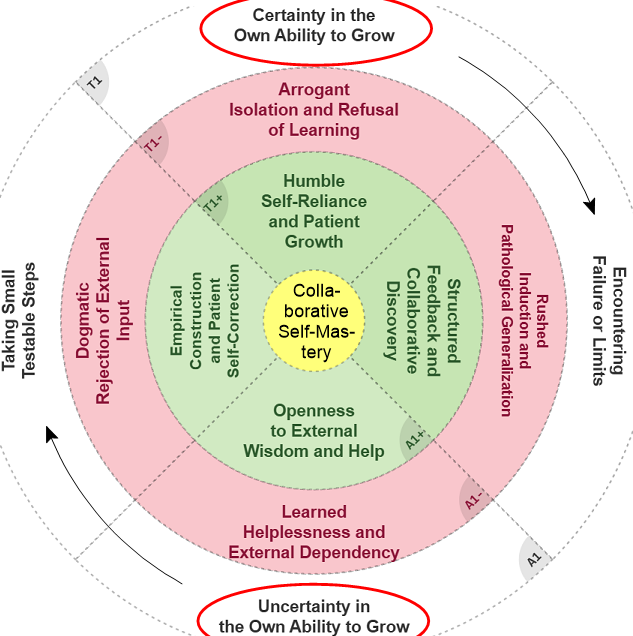
True certainty is our own capacity to grow. True wisdom is the ability to act when there is no certainty around.
Knowing that all foundational answers lie within us, we transform external limits into catalysts of our growth. The result is Deliberate, Collaborative Self-Mastery.
See Also:
- Certainty is not what people think
- The Certainty Trap
- How ideology distorts balance
- False Certainty in Business
- Breaking False Certainty with Eye Opener
- Fixing Leadership
- The Hidden Architecture Behind Corporate Success or Failure
- The Thread Toward Collective Decision-Making
- Introducing Structured Dialectics
- Eye Opener Overview
- When Right is Bad and Wrong is Good
- Artificial Intelligence or Artificial Ignorance?
- Two Paths of Compromise
- A Dialectical Resolution to the USA-Iran Conflict