

“There is nothing either good or bad but thinking makes it so.” – William Shakespeare
Policy and business run on implicit definitions of “good” and “bad.” Yet, global realities now expose their limits (e.g., Ostrom’s Polycentric Governance). Today’s logic—utilitarian reductionism (“what’s measurable = what matters”)—over-corrected earlier centuries of over-spiritualized moralizing (MacIntyre, After Virtue). Hegel predicted the next step: synthesis. We need it now—not only because the challenges are global, but because rules have ballooned while meaning has thinned (Power, The Audit Society; Muller, The Tyranny of Metrics).
Why simple definitions fail
Simple definitions capture only the surface (like a dictionary entry), while deeper essence needs a bit of a looping story. Physics does this all the time: Newton’s laws introduce concepts (inertial frame, force, mass, acceleration) that are defined and fixed through the very laws. That’s principled (constitutive) circularity: a testable, self-correcting loop, not sloppy logic.
Likewise with “good” and “bad”: non-circular formulas always smuggle in one side and silence the other (see e.g. The Problem of Value Pluralism and When Reasoning Yields Fallacy). Dialectical ethics keeps both sides in play—by design.
The circular definitions (depth sense)
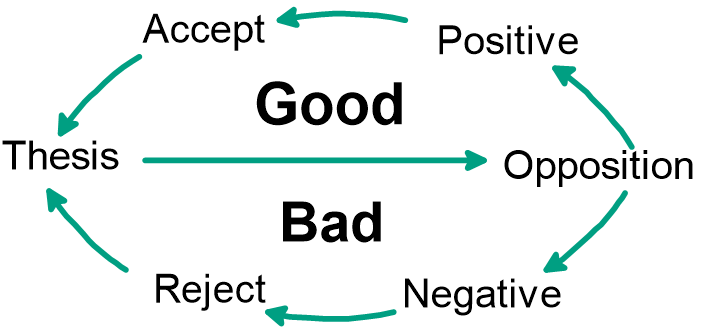
- Good: whatever fosters the positive side of an opposition.
- Bad: whatever demonizes an opposition (denies its positive aspects).
- Positive: mutual acceptance and complementarity of opposites—discerning the deeper essence beneath surface appearances, nurturing it, while maintaining your own.
This lets us design policies that are stronger than metrics and trends. What’s shared can be captured; what’s merely measured is often superficial. Essence must be sensed, not just scored.
Why this matters for leaders & policymakers
- Break false trade-offs: Compose each side’s positive (e.g., transparency and time-boxed confidentiality; speed and safety).
- Legitimacy & adoption: Policies that honor both sides earn bottom-up support.
- Resilience: Complementarity beats single-metric optimization.
Pocket playbook (use for strategy, OKRs, and regulation)
Step 1 — For any given Concept or Thesis (T) name its Opposition or Antithesis (A) and extract its positive side (A+).
- Science (T) ↔ Superstition (A)
T+ (science): rigor, replication, open correction
A+ (superstition side): creative freedom, humanistic mysticism, meaning-making
Synthesis: rigorous science that protects space for imagination and humane purpose. - Innovation (T) ↔ Risk (A)
T+ (innovation): exploration, velocity
A+ (risk): proportional safeguards, auditability
Synthesis: tiered sandboxes; obligations rise with stakes. - Centralization (T) ↔ Autonomy (A)
T+ (centralization): coherence, shared standards
A+ (autonomy): local fit, speed, ownership
Synthesis: common baselines + local overrides with transparent review.
Use the Eye-Opener to find the blind spot you’re missing (the neglected A+). Then re-compose policy or OKRs around both positives.
See how this helps resolving Gandhi’s Seven Social Sins, 100 Years On
Call to action
- When you face a “this vs. that” fight, name both positives and compose them.
- If a proposal demonizes the opposing side, it’s brittle—expect backlash.
- Use Eye-Opener to surface blind spots; turn strategies and OKRs into synthesis maps that show the A+ you’re protecting each quarter.
Good is what grows the positive of its opposition. Bad is what denies it.
Time for the synthesis.
See Also:
- Comparability of Good and Bad
- When Reasoning Yields Fallacy
- Rethinking Regulations
- See the Bigger Picture / Demo
- Israel Palestine Assessment Demo
- Turn Policies into Growth Maps
- Turn Objectives into Action Maps
- Dialectical Ethics
- Moral Wisdom from Dialectics
- Dialectical Wheels for Systems Optimization
- Wisdom Mining Protocol