

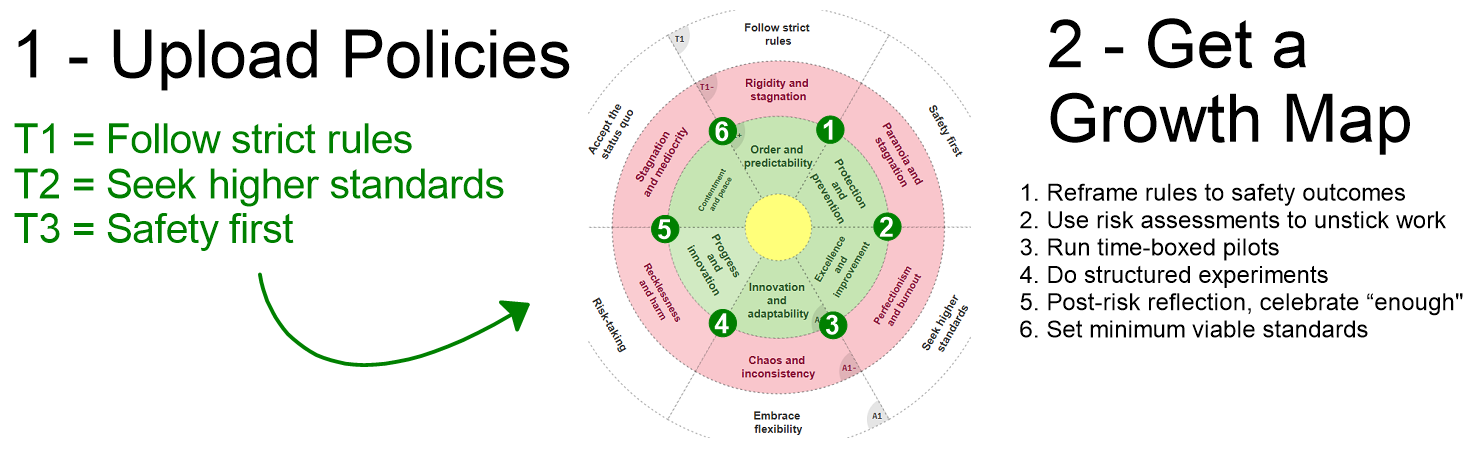
A practical way for policymakers to balance control and progress:
Eye Opener turns policy statements into Growth Maps—dialectical wheels showing the upside, the overreach, and the positive counterbalance. Then it recommends the next steps to turn tension into momentum (1-min demo)
Example 1 — Input: “Follow strict rules”
Every policy has an opposite. “Follow strict rules” has “Allow complete freedom” as its counterpoint. A policy is healthy only while it supports the positive side of its opposite—in this case, creativity and growth. Long-term wins come from combining the best of both, not from pushing one to an extreme. The diagram below shows this synthesis.
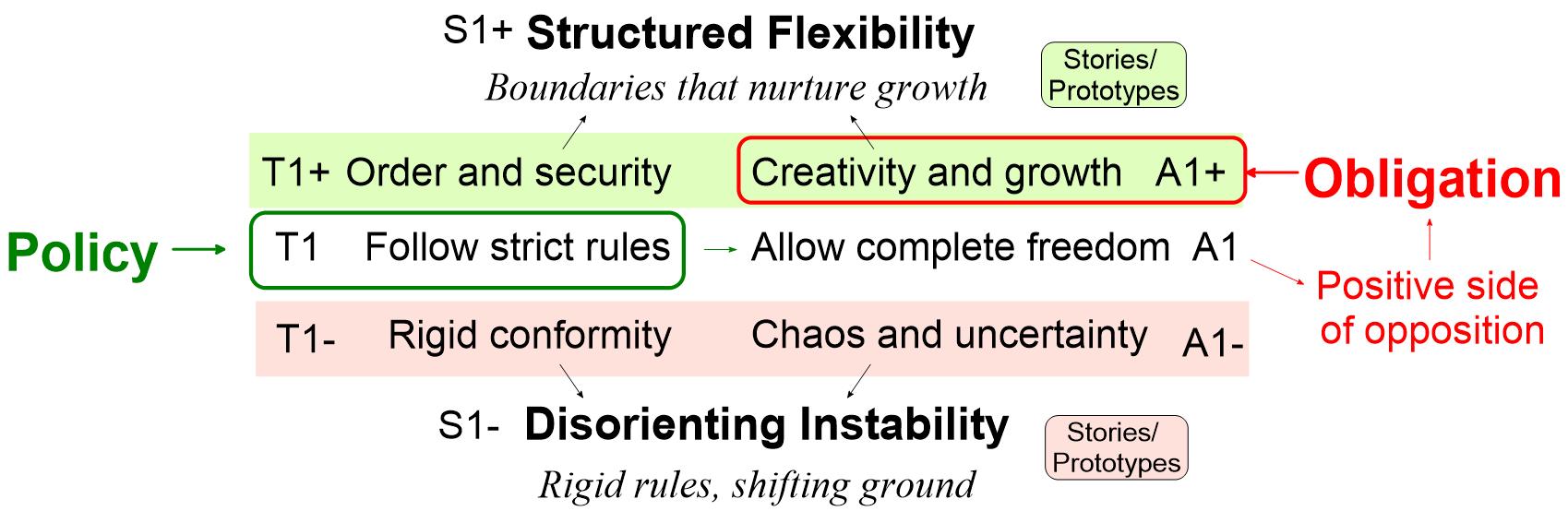
This diagram can be converted into the dialectical Growth Map that outines specific actions and reflections for converting the negative apsects of one policy into the positive aspects of another:
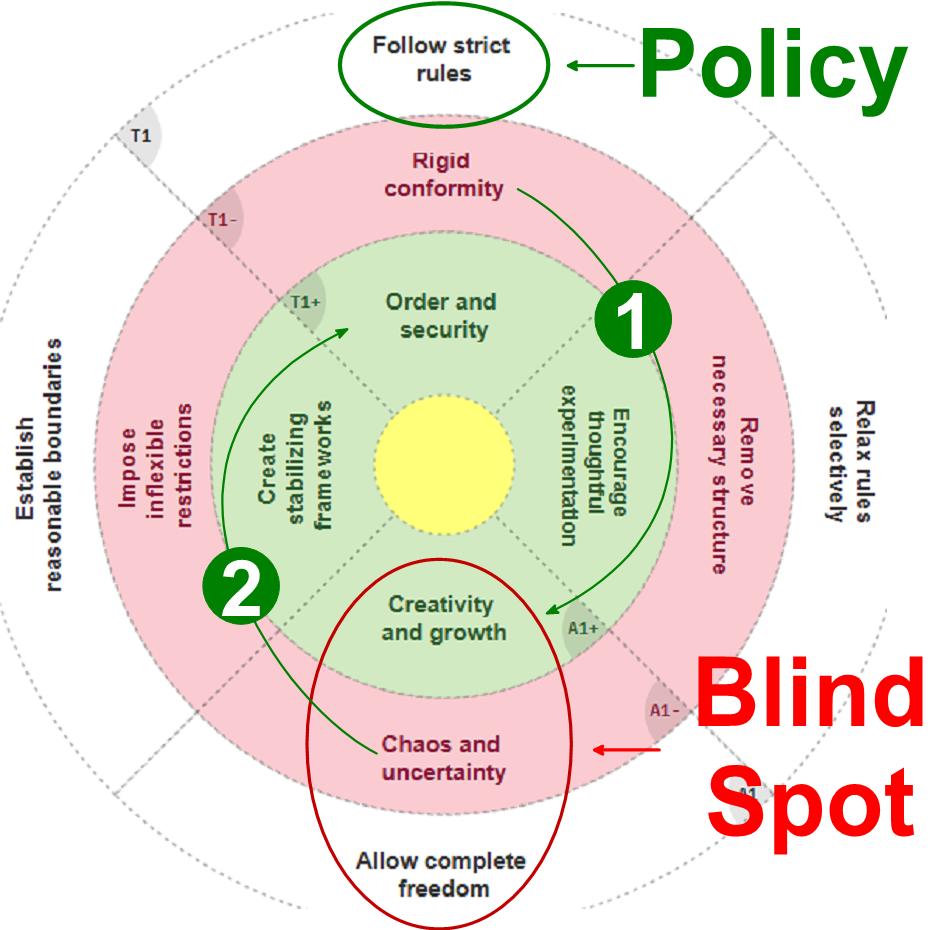
Step 1. Keep the principle, loosen the procedure. Define core non-negotiables; create safe-to-try experiments that honor those principles. Review outcomes, not paperwork.
Step 2. Name stability zones (must follow) and freedom zones (may vary). Publish boundaries; iterate based on results.
Result: policy keeps citizens safe and leaves room to adapt—without drifting into rigidity or disorder. See A Dialectical Case for Rethinking Regulation
Example 2 — Three policies at once
Consider the case of several policies at once:
T1: Follow strict rules · T2: Seek higher standards · T3: Safety first
For each policy we generate antithetical (blind spot) domains and arrange all policies into the optimal circular causality:
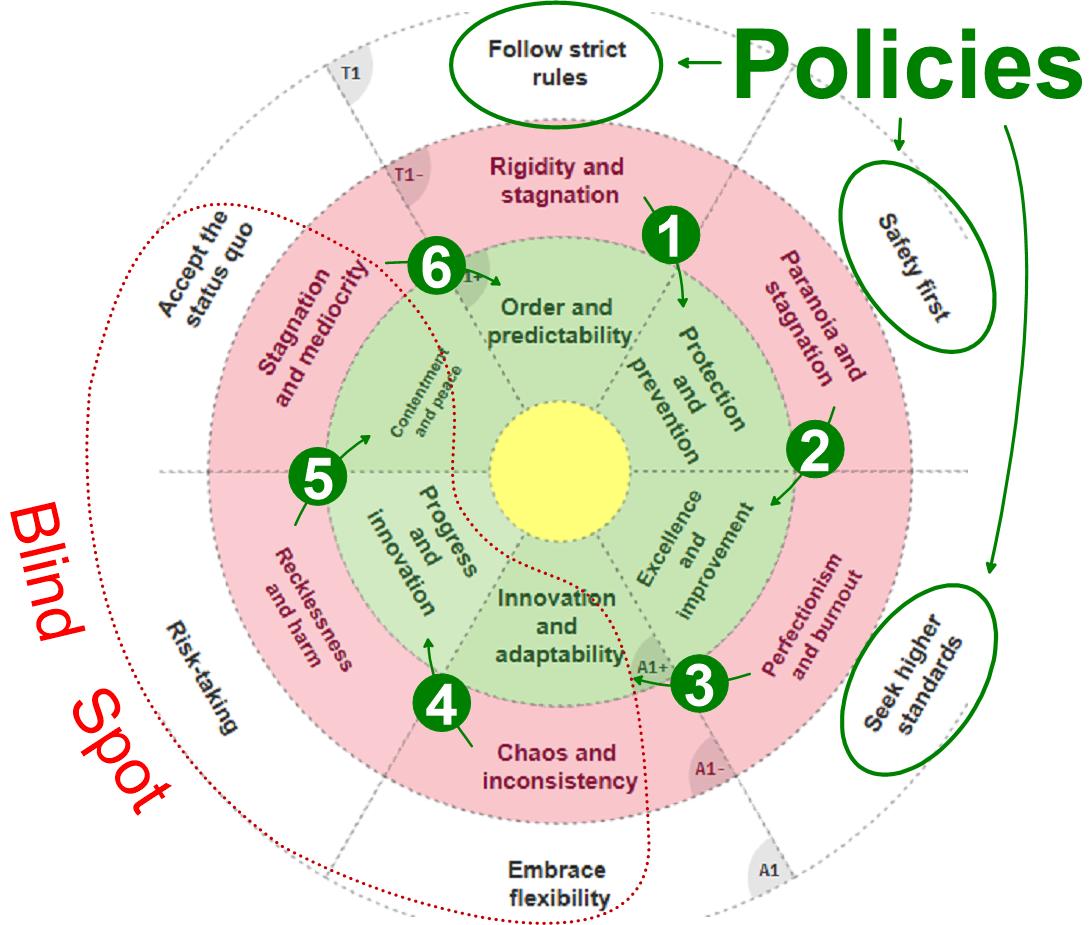
Six high-impact transitions:
Step 1. From Rigidity to Protection: Recast rules around safety outcomes; show incident reduction dashboards; teach the “why,” not just the “must.”
Step 2. From Stagnation to Excellence: Use risk assessments to unfreeze stuck areas; launch measured improvement pilots with clear safety thresholds.
Step 3. From inconsistency to Progress: Structured experimentation: define scope, metrics, stop conditions; regular reviews turn wins into practice.
Step 4. From Recklessness to Contentment: Post-risk reflection: document outcomes; keep only value-aligned risks; celebrate “enough” where goals are met.
Step 5. From Stagnation to Predictability: Set minimum viable standards; track visible baselines; review at a fixed cadence.
Step 6. Set minimum viable standards, track visible baselines, review on a fixed cadence.
Result: safety, excellence, and rules reinforce each other instead of stalling each other.
Try Eye Opener Now – You’ll get the map with transitions and feasibilities
See Also:
- The Shadow Side of Shiny Missions
- Company Preformance From Its Mission Wheel
- A Dialectical Case for Rethinking Regulation
- Turn Objectives into Action Maps
- Eye Opener Intro Demo
- Dialectical Wheels for Systems Optimization
- ISSS 2025 Oral Presentation Slides
- ISSS 2025 Poster – Cumulative Systems Optimization
- Dialectical Ethics
- Moral Wisdom from Dialectics