

For more than a century leadership research has revolved around one enduring tension:
Should organizations be top-down (efficient and controlled) or bottom-up (adaptive and self-organizing)?
This debate runs from classical management theory (Taylor, 1911) to modern complexity leadership (Uhl-Bien et al., 2007). In practice, every successful company combines elements of both (Yang et al, 2004; Lim et al, 2008). The challenge is knowing how much of each—and how to diagnose the hidden patterns that drive either resilience or stagnation.
This article introduces a 3-level diagnostic that helps leaders and consultants assess where their system stands and what to do next.
Level 1 — Assess Organizational Polarities
Most organizations unconsciously lean toward one side of six essential tensions (Fig. 1):
- Control ↔ Autonomy
- Structure ↔ Emergence
- Short-Term ↔ Long-Term
- Top-Down ↔ Bottom-Up
- Fear ↔ Psychological Safety
- Local Experiments ↔ Systemic Scaling
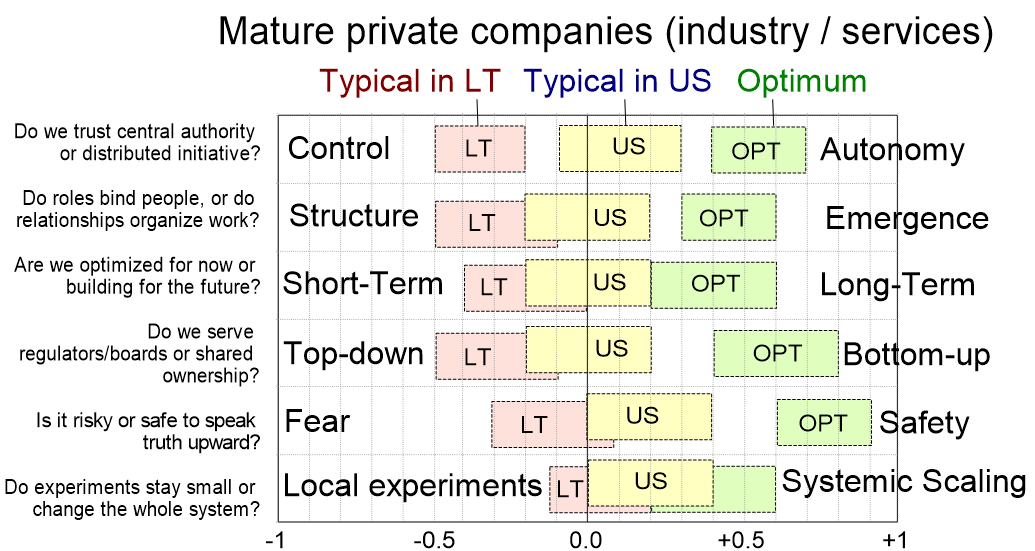
Many organizations in more traditional or legacy-oriented economies tend to be more centralized, formal, and compliance-driven. Meanwhile, firms in more innovation-intensive environments (e.g., the U.S., Nordic countries, parts of China and Brazil) show higher comfort with autonomy, experimentation, and cross-functional collaboration. The Likert-style definitions let you quickly score where your organization sits.
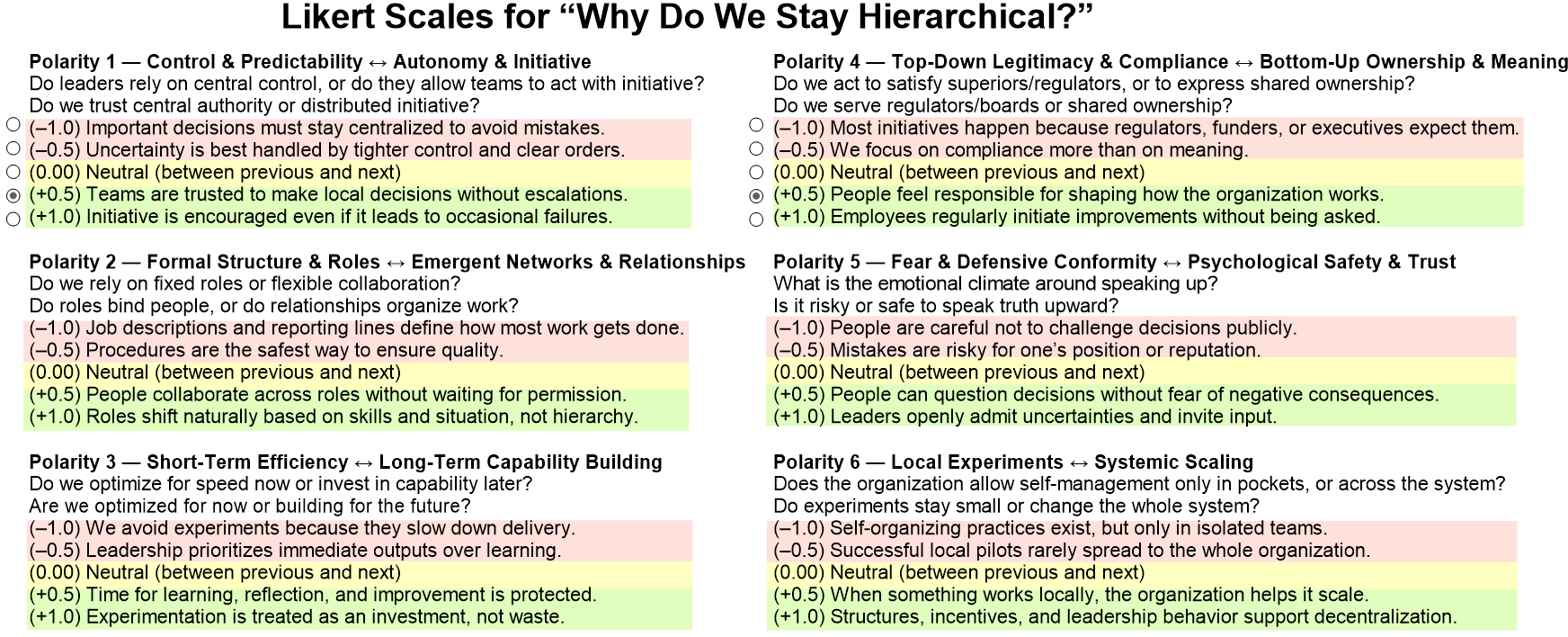
Note: Many leaders assume long-term capability means better infrastructure or more centralized systems. In this diagnostic, long-term capability means developing people, not expanding IT, reporting, or hierarchy. Infrastructure increases control; capability increases intelligence. This distinction is essential for accurate scoring.
Contrasting Cases
Across industries, the pattern is consistent:
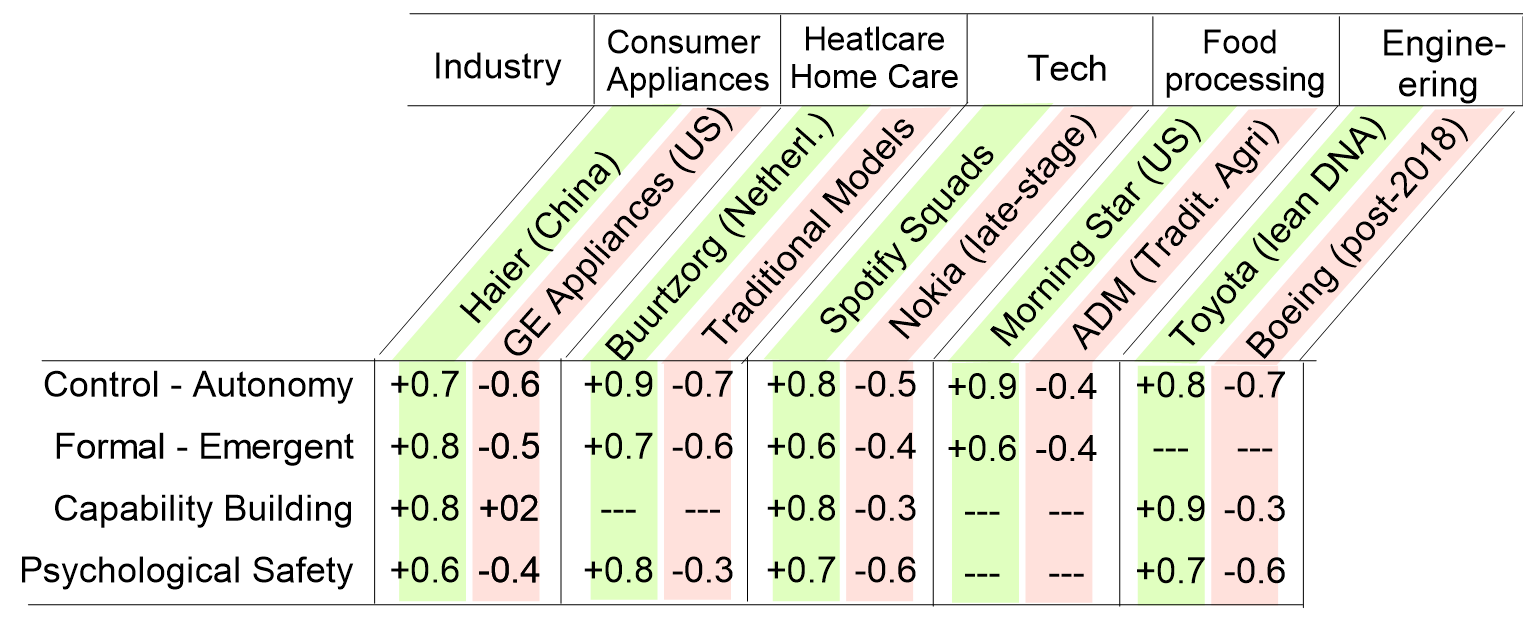
- Haier (China), Buurtzorg (Netherlands), Morning Star (US), and Spotify-model teams:
High autonomy, high safety, distributed initiative → higher adaptability and efficiency. - GE Appliances, Traditional Hospitals, ADM, Post-2018 Boeing:
More hierarchy, more formal roles, lower psychological safety → slower learning and lower resilience.
Self-management wins by combining autonomy with strong coherence.
Level 2 — Understand the “Why” Behind the Lean
Level 1 identifies where to look deeper. Level 2 explains why the pattern exists. Once a polarity shows imbalance, Level 2 identifies whether the system sits in:
- Healthy stability (T+)
- Healthy autonomy (A+)
- Rigid control (T–)
- Chaotic fragmentation (A–)
The chart on the right shows how to evaluate each quadrant for the first polarity pair.
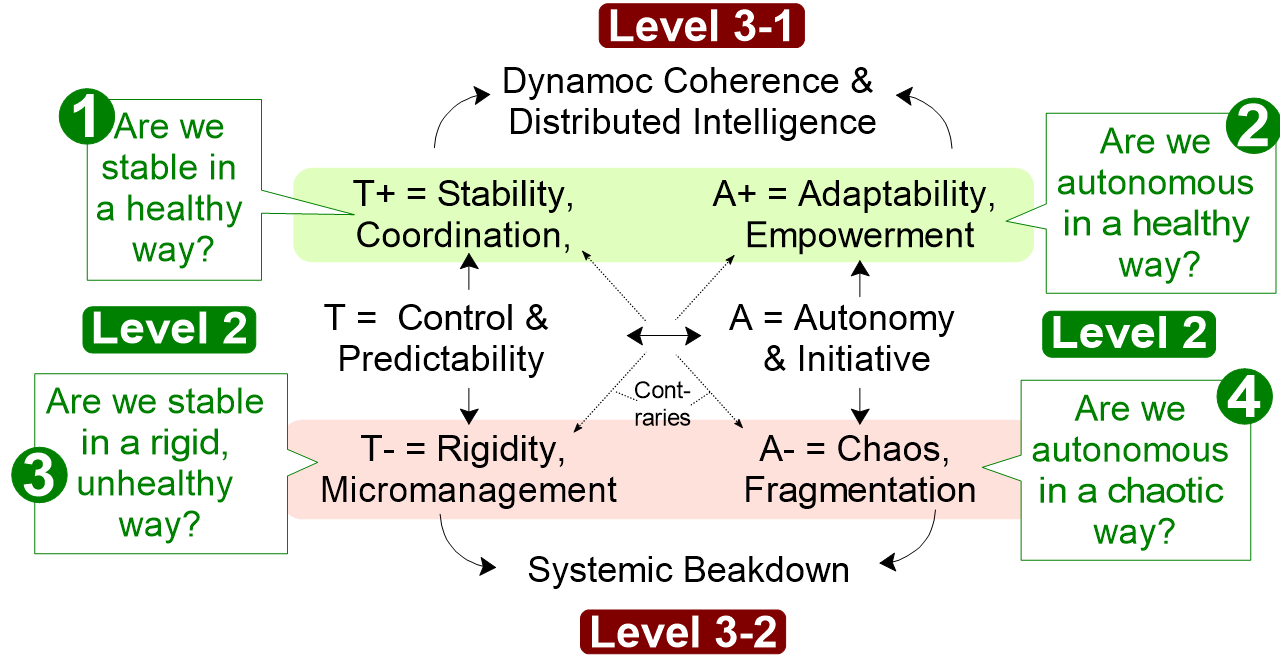
Each quadrant has targeted questions such as:
- Do teams hesitate to act without explicit permission?”
- “Are successful local innovations shared across the organization?”
- “Do approvals, permissions, or hierarchy slow work?”
- “Do experiments multiply faster than the organization can learn from them?”
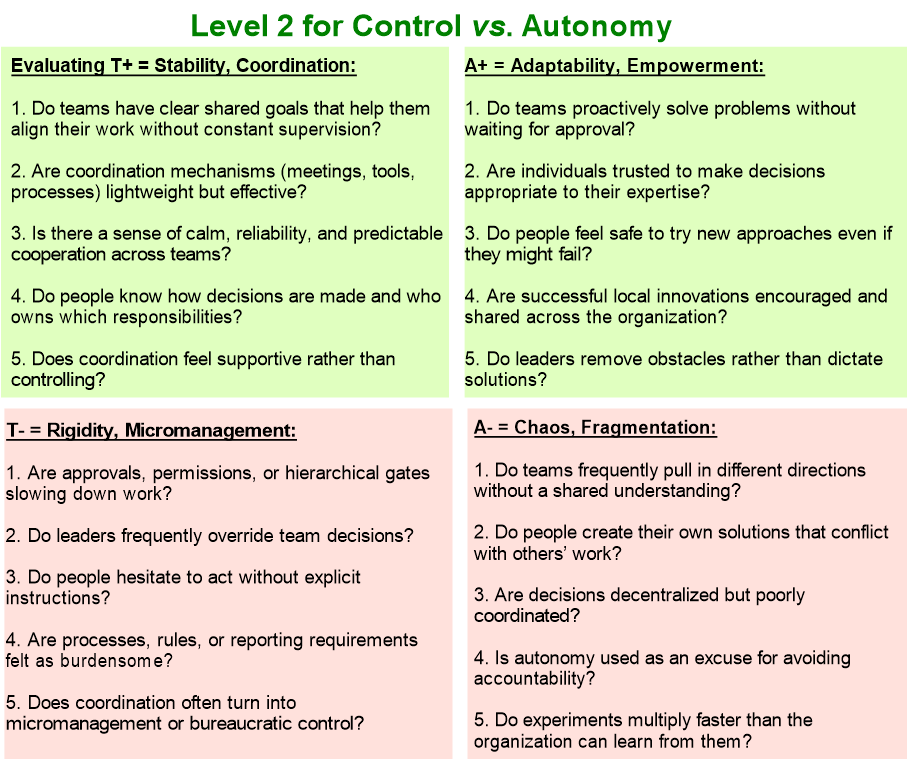
This reveals whether the company suffers from micromanagement, role rigidity, fear of speaking up, or uncoordinated autonomy.
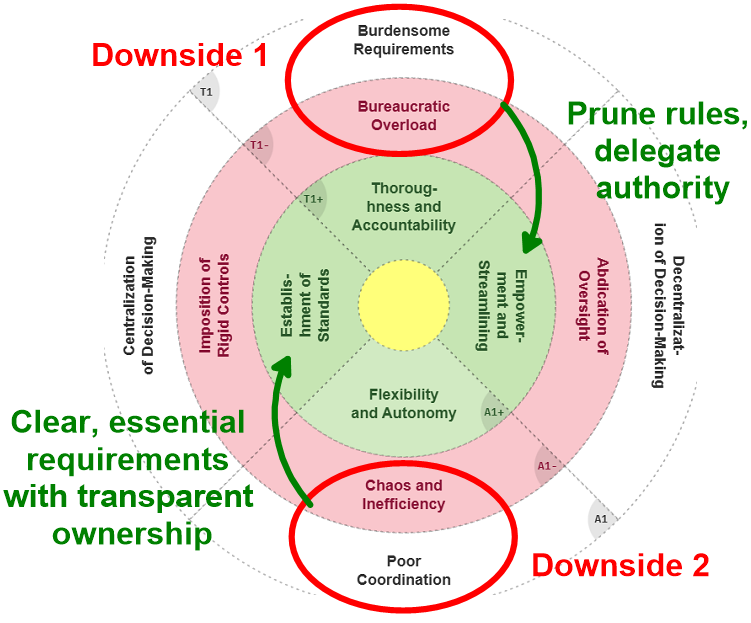
Once a specific downside pattern is identified, it can be converted into an upside through a simple polarity correction loop. The example on the left shows how two downsides are transformed into healthy strengths using a dialectical wheel.
Level 3 — Correct the Trajectory
Level 3 reveals whether the organization is trending toward:
- S⁺ Adaptive Resilience
(top-down clarity + bottom-up intelligence reinforce each other), or - S⁻ Sophisticated Imitation
(good narratives with weak capabilities; comfortable stagnation).
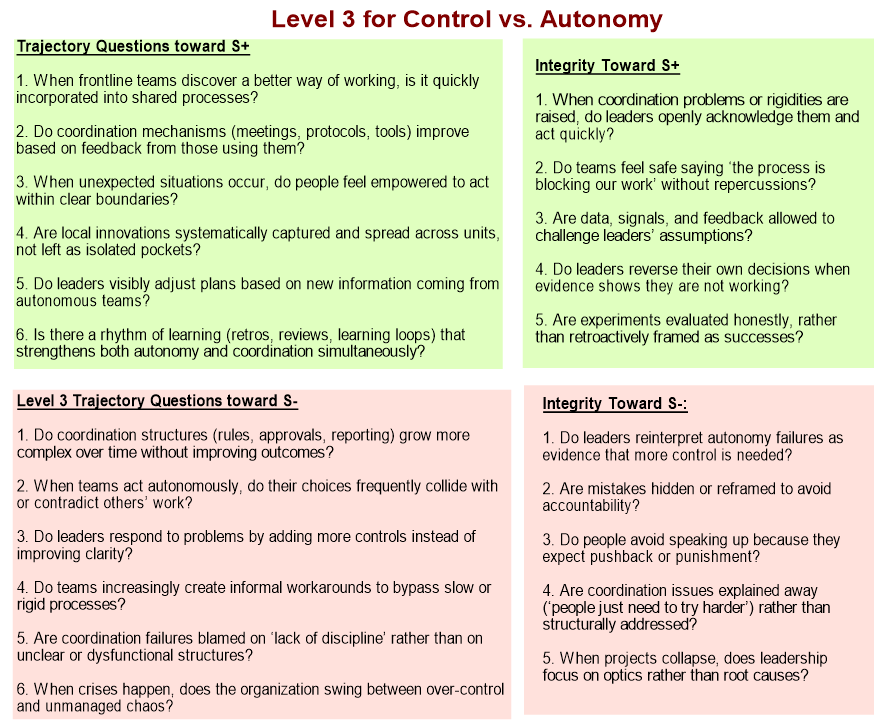
This is where traditional metrics fail and where real leadership begins. A fuller explanation of these dynamics is outlined in The Hidden Architecture Behind Corporate Success or Failure.
Why Should CEOs and Owners Care?
Because the data across industries is unambiguous:
Self-organizing companies
- react faster to crises
- innovate more reliably
- have higher engagement and safety
- outperform competitors financially
- scale resilience—not just processes
Hierarchy-dominant companies
- make slower decisions
- suffocate local initiative
- fall into “best practices” instead of real learning
- hide problems through layers
- decline suddenly after long periods of apparent stability
This is why Haier outperformed GE Appliances, why Buurtzorg disrupted home-care, and why Toyota’s long-term orientation beat U.S. automakers for half a century.
A Final Thought
Self-organization is not the opposite of hierarchy. It is what happens when hierarchy becomes a support system, not a control system. Your success depends on getting this polarity right.
If you want to explore your organization’s balance using the 3-level diagnostic—or compare yourself against global benchmarks—we’re happy to share the tools.