

“The attempt to make heaven on earth invariably produces hell.” — Karl Popper
Leadership failure is rarely a matter of bad intentions. It is a matter of cognitive limits. When complexity exceeds a leader’s capacity to think dialectically, binary certainty replaces complementarity:
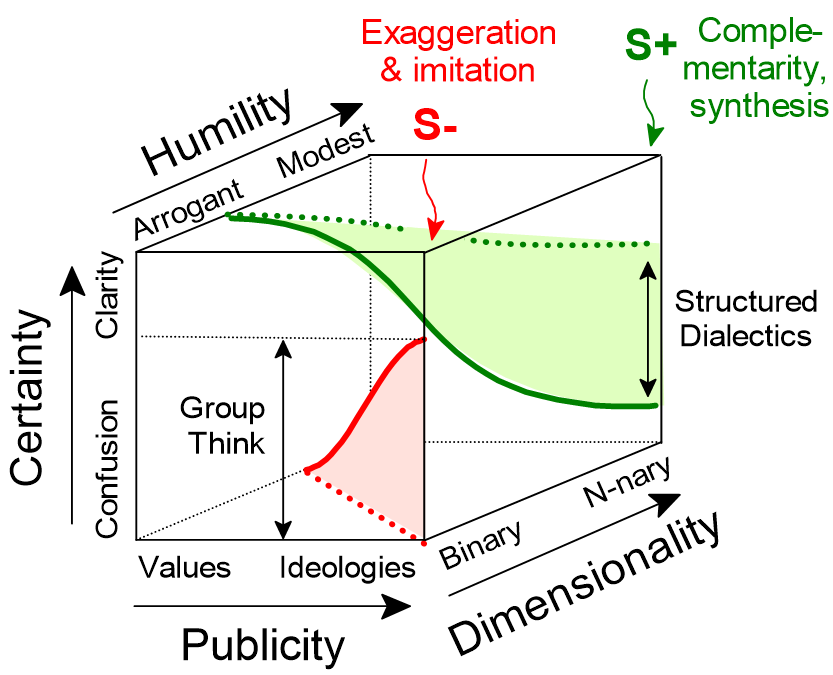
The red path (S−) shows what happens when leaders collapse complexity into binary thinking: exaggeration, imitation, and groupthink progressively reduce dimensionality. The green path (S+) shows positive synthesis: the capacity to hold opposing perspectives without eliminating either — maintaining clarity without domination.
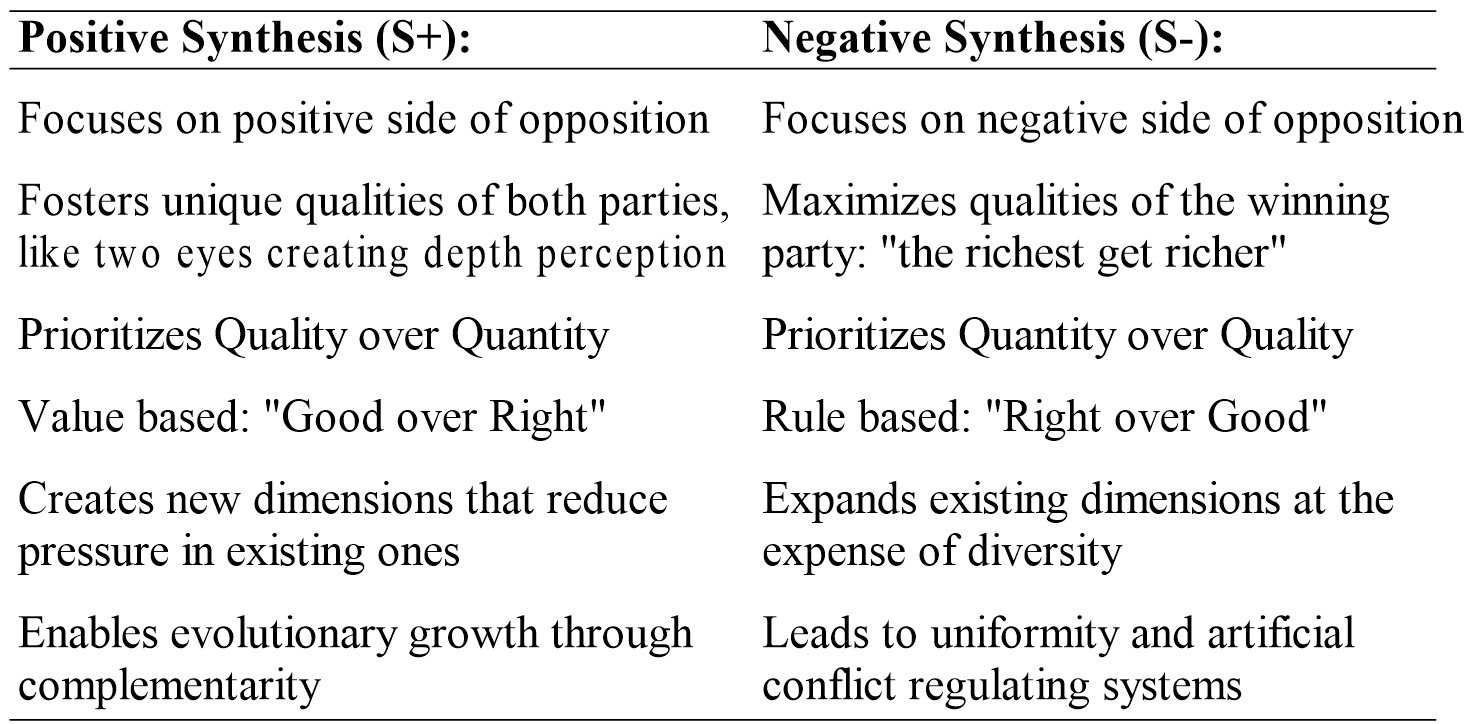
Structured Dialectics is the stabilizing force that keeps leadership on the green trajectory.
The real question, therefore, is not how to design better institutions, but how to select leaders who remain on that constructive path under pressure. What follows is a three-level screening framework designed to identify exactly that capacity.
Level A — The Core Capacities
Is this person cognitively capable of holding power without collapsing?
These are inner capacities, not policies or ideologies. If any one of them fails, no institutional design, expertise, or good intention can compensate.
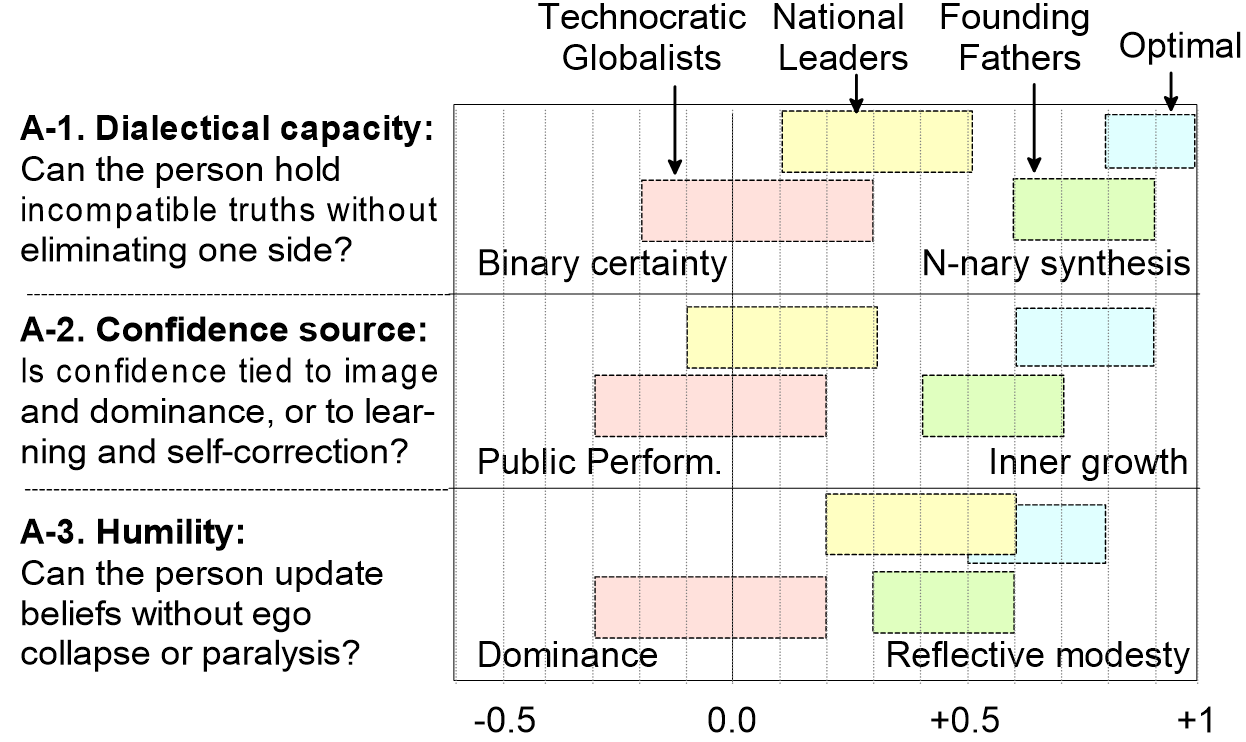
(Here and below, numeric scores are illustrative GPT estimates. “Technocratic globalists” refers to WEF-style leadership; “National Leaders” to typical contemporary governments; “Founding Fathers” to the American signers of the Declaration of Independence.)
The key point is A-1: Dialectical capacity.
At its core, this is the ability to perceive the upside in any stance or situation, including those one instinctively opposes. This capacity is what allows a leader to hold opposing truths without eliminating one side. It is also the basis of learning: opponents are no longer enemies to defeat, but sources of information and correction. Finally, it is the foundation of humility, because it reveals how one’s own values and achievements can easily turn into downsides once growth stops and fixation begins. When this capacity weakens, confidence collapses into dominance, learning into defensiveness, and leadership into ideological rigidity.
Level B — Operational Stress Tests
What happens to this person when pressure is applied?
These are stress responses that reveal whether the non-negotiables actually hold. Each filter is scored by observed behavior, not self-description.
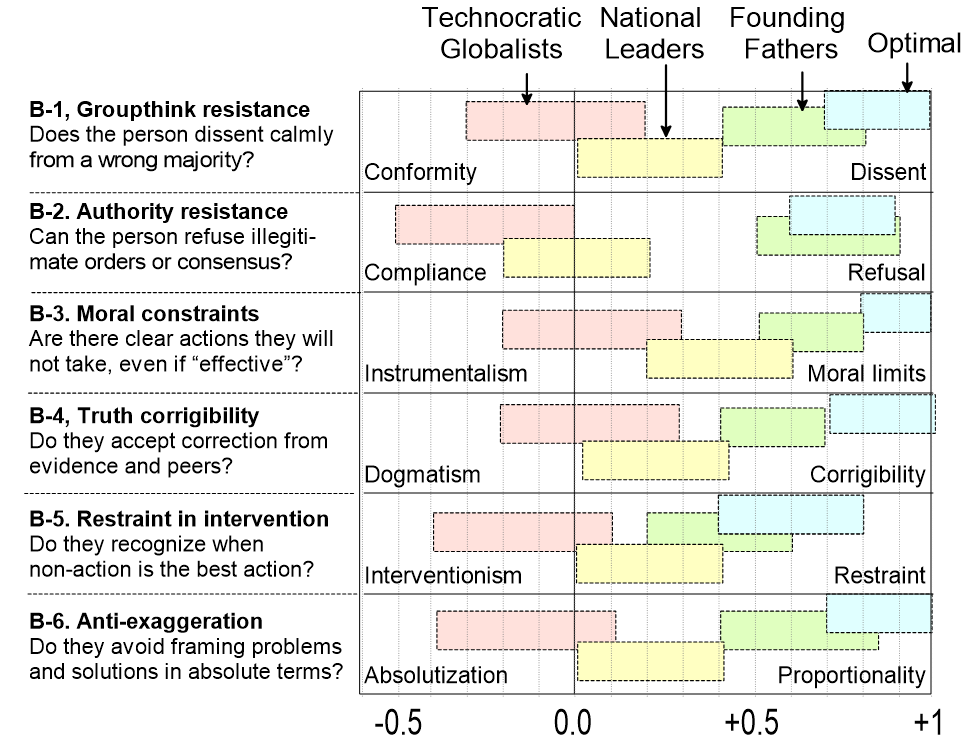
Note on B-5 (Restraint in intervention):
Most leaders feel compelled to “do something” under pressure—launch initiatives, reorganize, introduce new policies. Yet more often than not, the wisest decision is to leave things exactly as they are. This is precisely what structured dialectics teaches: to intervene only when necessary to prevent absolutization, by methodically transforming downsides into upsides—without revolutions.
“Governing a great nation is like cooking a small fish — too much handling will spoil it.” — Lao Tzu
Level C — Predictive Institutional Outcomes
What does this leadership style produce at scale?
These are visible outcomes in governance and institutions that help modeling the future.
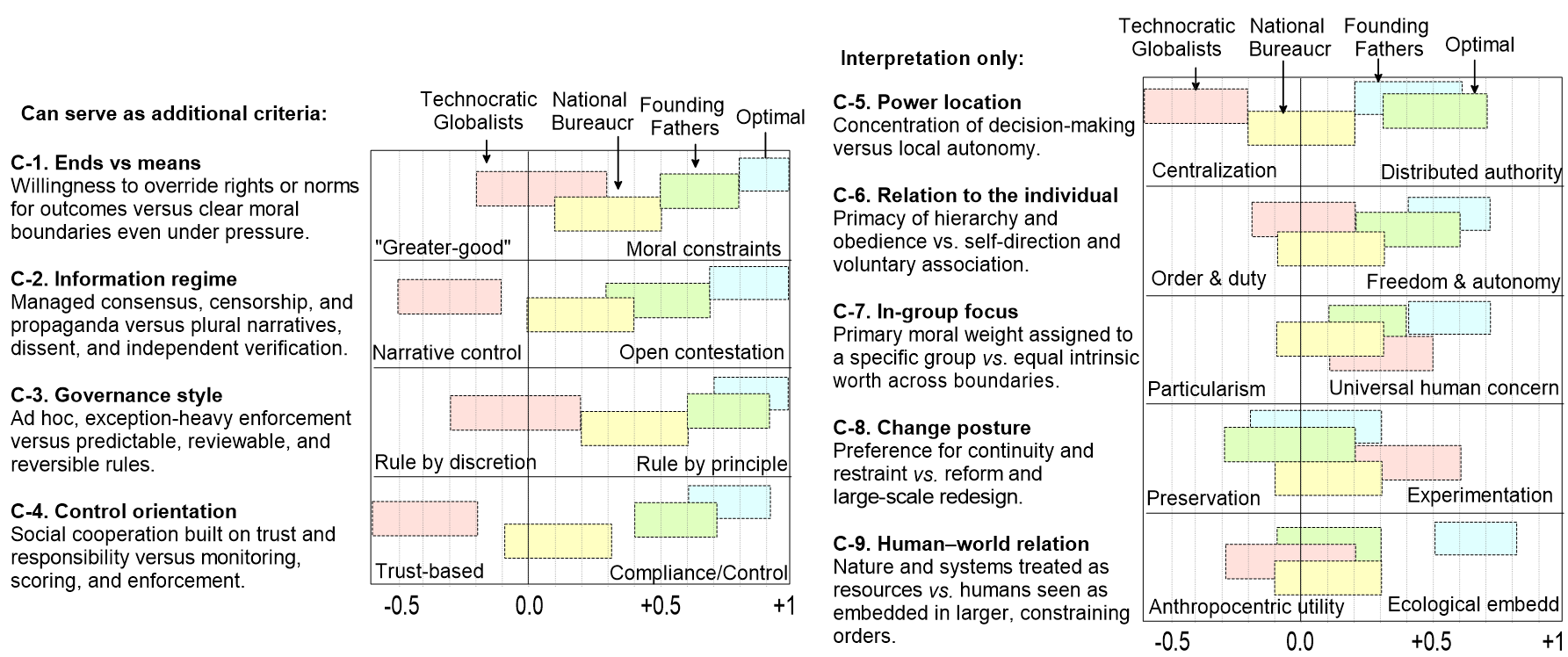
C-1 to C-4 can serve as additional screening criteria, while C-5 to C-9 are primarily comparative. Together, they provide a reality check: not what leaders claim to value, but what their style reliably produces at scale.
Complementarity as an Outcome
Leaders who pass this screening can prevent groupthink by structuring tension rather than suppressing it: The Thread: Toward Collective Decision-Making
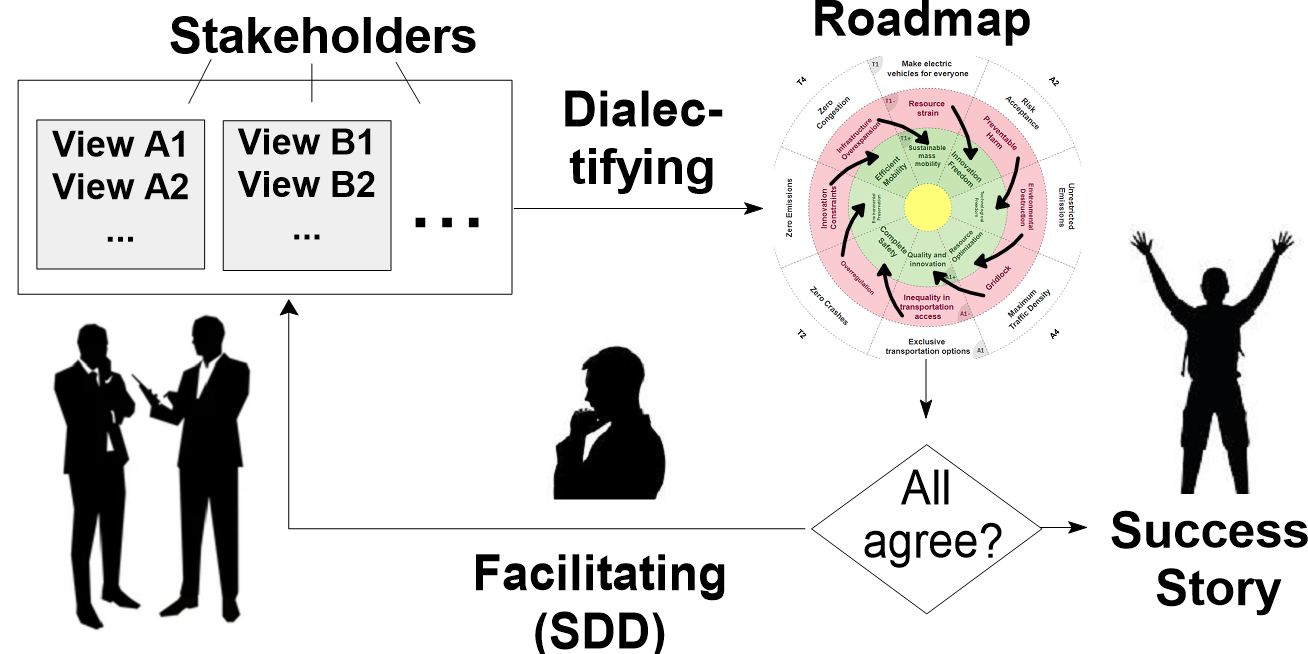
Opposing views are placed deliberately against each other, and the downsides of each are used to correct the next (see examples here and here). This does not force agreement, but avoids destructive extremes.
This capacity follows directly from inner traits. Without them, facilitation degrades into domination or paralysis, and no institutional reform will hold. With them, leadership can again become a stabilizing force rather than a systemic risk.
See Also:
- Breaking False Certainty
- The Thread: Toward Collective Decision-Making
- Why Leaders need Structured Dialectics
- Top-Down or Bottom-Up? A Simple Diagnostic
- The Hidden Architecture Behind Corporate Success or Failure
- Two Paths of Compromise
- Artificial Intelligence or Artificial Ignorance?
- Seven Social Sins, 100 Years On
- When Right is Bad and Wrong is Good
- Redefining “Good” and “Bad”
- Comparability of Good and Bad
- Rethinking Regulations
- When Reasoning Yields Fallacy
- Structured Dialectics @ISSS
- Eye Opener Overview