

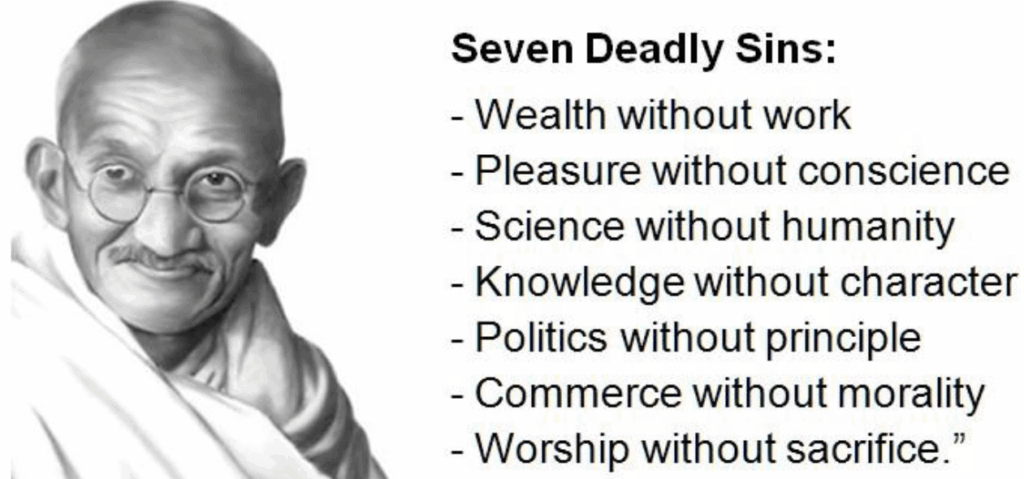
On October 22, 1925, Mohandas K. Gandhi published his “Seven Social Sins” in Young India. A century later, they’re still quoted—and still needed. For a contemporary angle on their roots, see our related essay: “When Right is Bad and Wrong is Good.”
How to avoid the sins using Structured Dialectics:
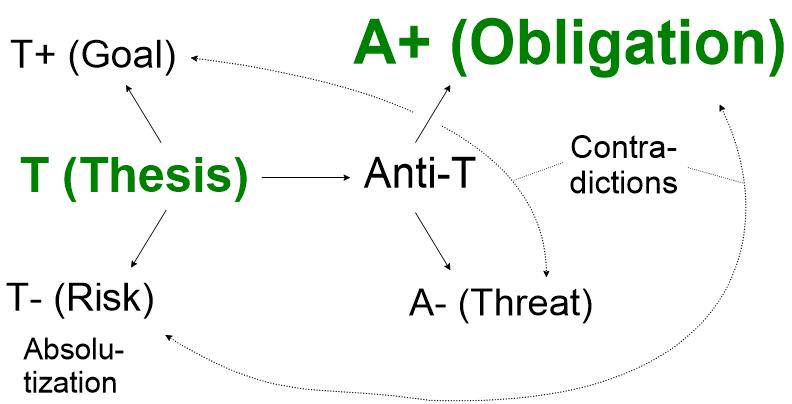
- Pick a Thesis (T) you value.
- Name its Opposition (A)—the counter-pole.
- Extract the positive side of A (A⁺)—the part that corrects T’s excess (T⁻).
- Treat A⁺ as your obligation to keep T healthy.
The Seven, reframed
1) Wealth without work
T = Wealth ↔ A = Poverty → A⁺ = Work & Simplicity
Obligation: Link wealth to contribution and restraint.
2) Pleasure without conscience
T = Pleasure ↔ A = Austerity → A⁺ = Conscience & Responsibility
Obligation: Set boundaries that protect others’ dignity.
3) Knowledge without character
T = Knowledge ↔ A = Ignorance → A⁺ = Character & Openness
Obligation: Seek truth with humility and accountability.
4) Commerce without morality
T = Commerce ↔ A = Self-sufficiency → A⁺ = Morality & Independence
Obligation: Fair dealing; real options to exit (no coercive lock-in).
5) Science without humanity
T = Science ↔ A = Sentiment → A⁺ = Humanity & Care
Obligation: Human-impact reviews; red-team harms; mitigate by design.
6) Religion without sacrifice
T = Religion ↔ A = Secularity → A⁺ = Sacrifice & Integrity
Obligation: Walk the talk; don’t outsource costs to others.
7) Politics without principle
T = Politics ↔ A = Private Life → A⁺ = Principle & Transparency
Obligation: Proportionate rules, explainable trade-offs, sunset clauses.
For every cherished T, there’s an A⁺ you’re obliged to honor. Good fosters A⁺ alongside T. Bad demonizes A⁺—and courts backlash.
All of this can be dome automatically with Eye Opener application
See Also:
- When Right is Bad and Wrong is Good
- Moral Wisdom from Dialectics
- Redefining Good and Bad
- Rethinking Regulations
- See the Bigger Picture / Demo
- Israel Palestine Assessment Demo
- Turn Policies into Growth Maps
- Turn Objectives into Action Maps
- Dialectical Ethics
- Dialectical Wheels for Systems Optimization
- Wisdom Mining Protocol