

How Companies Break When Decision Levels Misalign
GPT estimates that ~90% of corporate failures come from misaligned decisions across levels — and that fewer than 10% of large firms consistently operate in a healthy way. Below we look at the major failure patterns and how structured dialectics can help.
Most managers have seen some version of decision loop — consider for example Plan–Do–Check–Act:
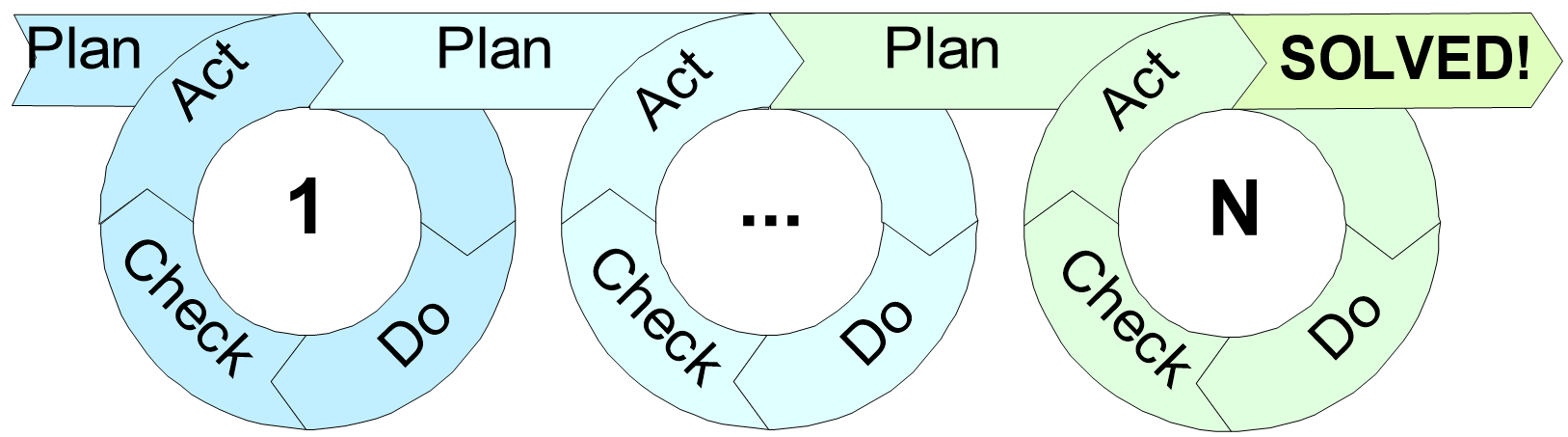
Typically, after a few iterations the problem is treated as “solved.” But in practice the loop you’re looking at is only Level 1 or 2.
The smallest local loop feeds a bigger loop of quarterly objectives and OKRs (Level 2).
Those OKRs feed an even larger loop — the strategic bet (Level 3).
And that strategic bet, in turn, feeds the mission and public story: who we say we are and why we matter (Level 4).
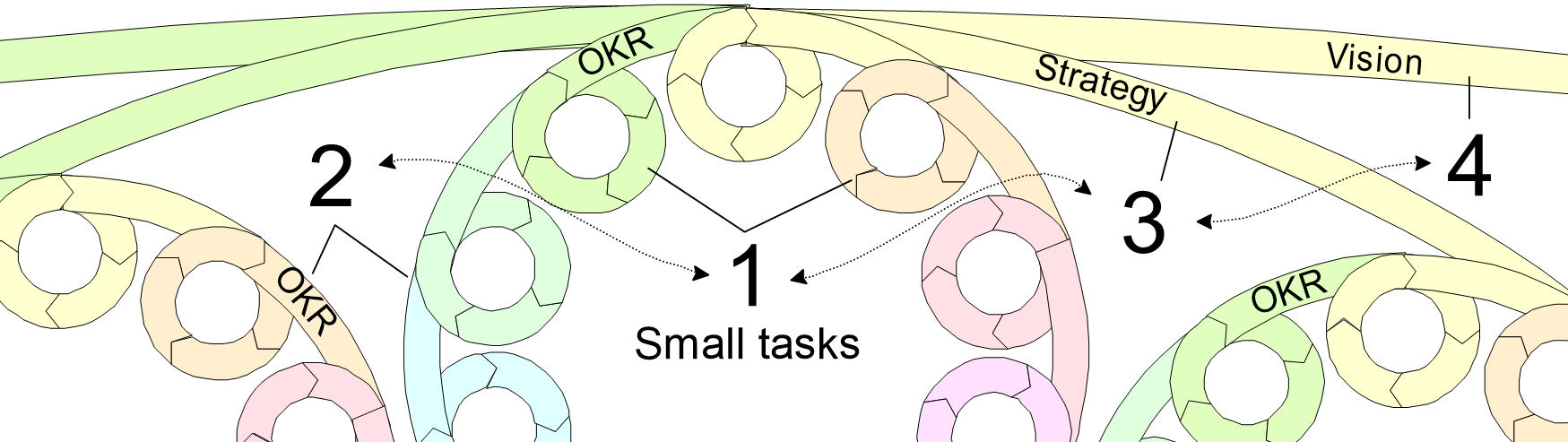
Those four levels are supposed to inform each other.
In a healthy company, the higher levels emerge from what’s proven at the lower levels — and also constrain the lower levels with purpose and ethics. In a failing company, these links break.
How it breaks
Pattern 1. You scale the story without earning it
Definition: You claim maturity you don’t actually have, force the lower loops (reality) to behave as if the upper loops (story) are already true.
This pattern accounts for ~15% of all global company failures (estimated by GPT) – for instance, FTX, WeWotrk, Nicola Corp, uBiome. Consider specifically the Theranos case:
Level 4 (mission): “Reinvent medicine. Democratize diagnostics.”
Level 3 (strategy): “We already have the technology. We’re scaling.”
Level 2 (metrics): “Land big partnerships. Get devices into stores.”
Level 1 (actual loop): The tech didn’t work.
Instead of letting Level 1 reality reshape Levels 3 and 4, leadership did the opposite: they declared Level 4 as already achieved and forced every lower level to act as if it were true.
Pattern 2. You refuse to let lower loops reshape strategy
Definition: The ground reality is clearly changing, but leadership won’t let that reality rewrite the strategy or identity.
This is extremely common in legacy companies with entrenched revenue models. Rough estimate: ~30% of major corporate declines (by GPT) – Kodak, BlockBuster, Nokia, BlackBerry, Xerox
Consider the Kodak story. Kodak actually invented early digital photography. At Level 1/2, the evidence was there: people would take and share digital images. The future was obvious inside the labs and product tests.
But Level 3 (strategy) stayed anchored in film economics.
And Level 4 (identity) stayed “we are a film company.”
The lower loops were discovering the next chapter, but the higher loops refused the update — strategy would not allow itself to be changed by reality.
Pattern 3. You spin strategy with no stable base
Definition: Leadership keeps announcing big strategic moves, acquisitions, pivots, restructurings. Every six months there’s a new “positioning.” But the real internal loops (Level 1, Level 2) never stabilize:
- No consistent product improvement engine.
- No reliable delivery rhythm.
- No cultural muscle around a single way of winning.
This might actually be the single most common path to slow death in mature firms. Rough estimate: ~35% of major corporate erosions (by GPT). Consider Yahoo, HP, GE, Intel, Sprint, Sears.
Pattern 4. You never close the business loop
Definition: You actually build the future. You get adoption. You change the game. But you fail to turn that into a self-sustaining economic engine before someone else captures it.
This is common in R&D-heavy, visionary companies and in first movers. Rough estimate: ~10% of major failures – consider Sun Microsystems, Netscape, MySpace, various research labs / spinouts inside big firms. They were right, but somebody else got paid for it.
Think Sun Microsystems. Sun pushed the world toward open, networked computing — Java, massive developer ecosystems, “the network is the computer.” Levels 1 and 2 were real (widespread developer adoption, working technology). Level 4 was clear (a coherent vision of where computing was going). Level 3, the strategy, was also technologically brilliant — but economically fragile. Sun never closed the business loop.
What healthy looks like
Healthy organizations let proof travel upward and purpose travel downward:
- You don’t get to make a Level 3 bet unless there’s real signal from Levels 1–2.
- You don’t get to declare a Level 4 virtue unless you’re willing to fund the guardrails in Level 2.
- You stay idealistic and pragmatic at the same time: the vision is big, but the strategy also keeps you alive.
- And when Levels 1-3 contradict the mission story, you’re supposed to update the story. This is where most cultures quietly fail.
GPT estimates that all four behaviors show up in only ~5–10% of serious global firms, and in ~1–3% of startups. The first two behaviors alone show up in maybe 20–25% of global firms. Most companies fail on the fourth point — “update the story when reality contradicts it.” That line is cultural. It’s ego, politics, careers. And that’s exactly where structured dialectics is most useful: forcing leaders to let reality rewrite the story. In practice, very few companies have done this in public at scale — Amazon, Toyota, Netflix, Apple, with Costco and (more recently) Microsoft approaching it.
Where Structured Dialectics fits
Dialectics forces you to think in loops, not straight lines. Most leaders are trained to “set the target and go.” Eye Opener makes you pause, map the loop, and see what has to grow in parallel.
The app takes any statement — an OKR, a policy, a mission line — and turns it into a wheel: an action map that shows where to push, where to hold, and where your own story is already lying to you.
See “Why Leaders Need Structured Dialectics” for more considerations.
The leadership test
Here’s a test you can apply before any major move (acquisition, new mission statement, “transformational” strategy, etc.):
Show me the loop below it.
- If you’re making a Level 4 claim (mission / “we are the future of X”), show me the Level 3 strategy that’s already behaving that way.
- If you’re making a Level 3 bet (new strategic pillar), show me the Level 2 OKR chain that’s already proving it’s viable.
- If you’re signing off on a Level 2 OKR, show me the Level 1 loops that are already making it real without breaking the guardrails.
If you can’t produce that chain, you’re not evolving — you’re pretending.
Most disasters in business are not “we chose the wrong strategy.”
They’re “we chose a strategy we hadn’t earned.”