

“He who knows only his own side of the case knows little of that.”
— John Stuart Mill
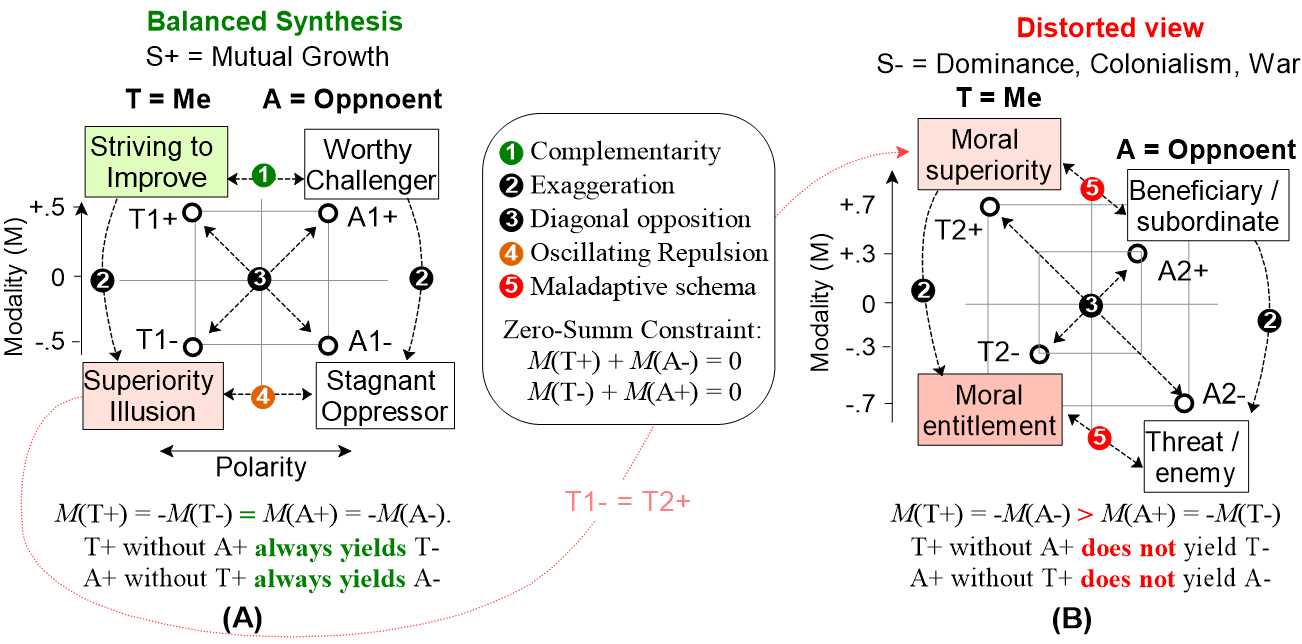
All wars are caused by ideologies that shrink the world into binary absolutes, turning opponents into enemies and obstacles. Structured Dialectics helps to break this cycle by revealing the interdependence of opposing poles. Every thesis (T) and antithesis (A) exist within a shared system of constraints:
See the Generative Rules for Synthesis Prediction
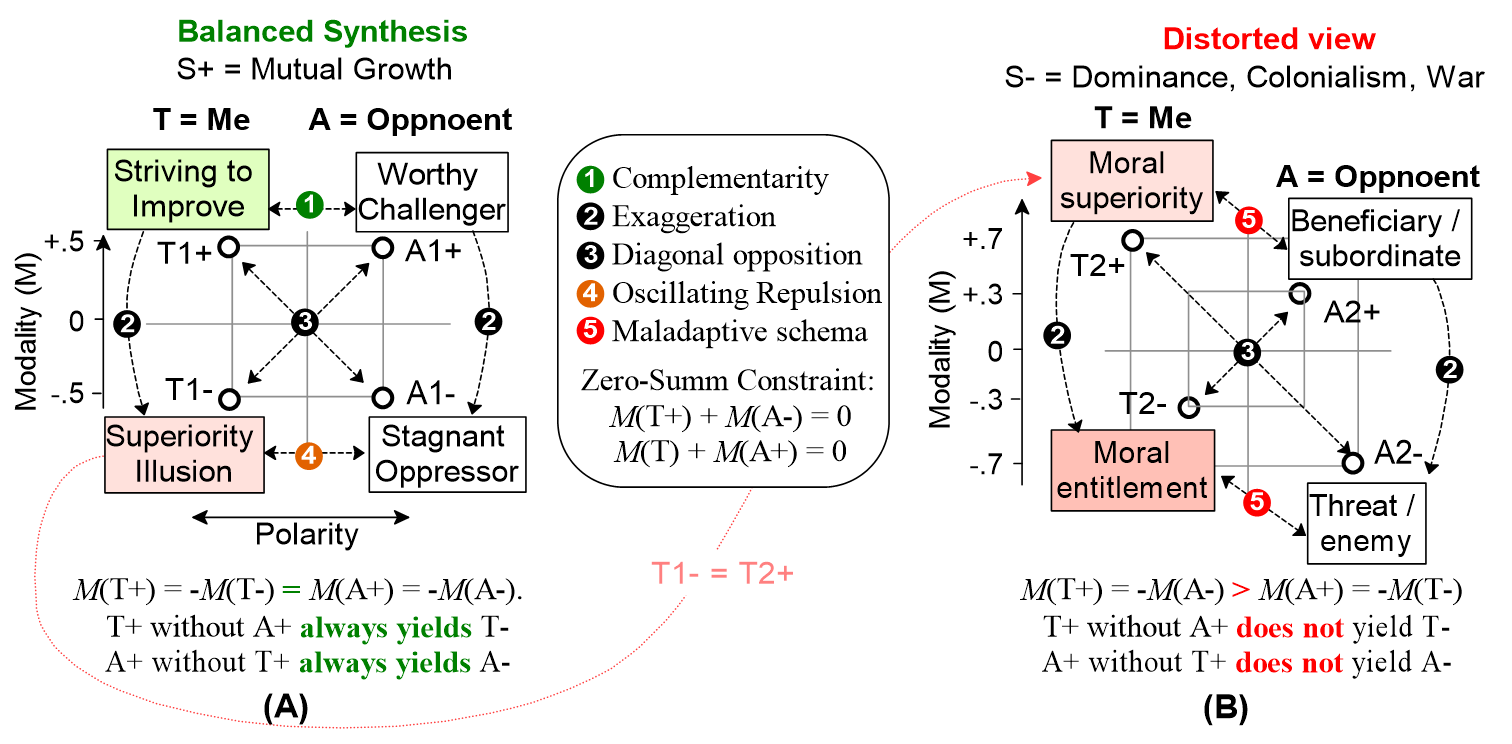
When both poles are balanced, we can learn from each other (scheme A). But when either pole is exaggerated, learning gives way to dominance (scheme B). What appears to be moral clarity turns out to be an illusion of superiority. Note that in scheme B the positive pole T2+ corresponds to the distorted pole T1− from scheme A, while the overall geometry of the system shifts from rectangular to rhombic.
This constrained four-pole structure allows distortions to be captured more precisely than conventional analysis of linguistic signals. By making such distortions visible, it enables a vital realization: destroying one’s enemy is intellectually self-destructive. If opposition carries information about the limits of our own position, eliminating it removes the very mechanism that could make us wiser.
Where ideology demands loyalty to a single truth, Structured Dialectics demands discernment between the positive and negative potentials (see Redefining Good and Bad). In doing so, it reconnects rational analysis with moral growth, and technological power with human wisdom (see The Real AI Dilemma).
See Also:
- Ideology distorts everything – especially the truth
- The Myth of Rational Thinking
- Why Fact-Checkers Need a Dialectical Audit
- A Dialectical Resolution to the USA-Iran War
- Generative Rules for Synthesis Prediction
- The Real AI Dilemma
- Fixing Leadership
- Dialectical Ethics
- Moral Wisdom from Dialectics
- Redefining Good and Bad
- When Right is Bad and Wrong is Good
- Think Against Yourself