

“Belief creates the actual fact” ~ William James
Modern fact-checking operates on two flawed premises: that “facts shape belief” and that “certainty is the goal”. In reality, belief determines which facts matter, while premature certainty acts as a blindfold. A claim can be verified as true and still lead to harmful outcomes (cf. Suomalainen et al., 2025).
We propose a shift from binary verification to dialectical auditing—moving from retrospective “policing” to prospective risk mitigation.
Eye Opener is a dialectical tool designed for this shift. Any claim (Thesis) is provided with “anti-claim” (Antithesis) and their synthesis prediction(s). This helps to shift focus from “what was the past” and “who is right” to “what will be the future”.
Example 1: Public Health Claim
Claim (T): Boosters increase antibody levels. Verdict: TRUE.
Antithesis (A): Boosters diminish natural adaptive capacity — must also be TRUE, since (1) every thesis exists only in conjunction with a complementary antithesis, and (2) under conservation principles, strengthening one immune pathway necessarily reallocates resources, emphasis, or adaptive pressure away from others:
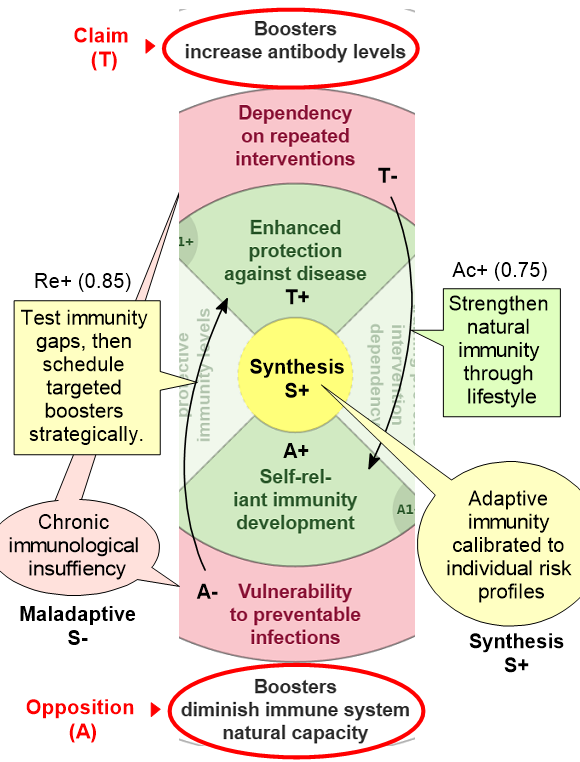
T+ (Upside): Enhanced protection against disease
T− (Downside): Dependency on repeated interventions
A+ (Upside): Self-reliant immunity development
A− (Downside): Vulnerability to preventable infections
Conditions for synthesis emergence:
Ac+ (T- → A+) = Improve Lifestyle
Re+ (A- → T+) = Test immunity gaps
| One-sided (T+) Optimization | Dialectical (S+) Optimization |
| Boost with maximum doses and frequency | Boost only after testing immunity gaps, then allow restoration via healthy lifestyle |
Dialectical (S+) optimization redirects analysis from merely confirming antibody spikes to evaluating their systemic impact, indicating two critical flaws of the one-sided optimization:
- the risks of exaggeration (T-), such as T-cell exhaustion and systemic overdosing (cf. Gao et al., 2022), and
- the benefits of the antithesis (A+), including the self-regulating versatility of the autoimmune system (Muraille, 2014), the advantages of under-dosing (Rhodes et al, 2019), and the accelerated herd immunity provided by population heterogeneity (Britton et al, 2020).
Conclusion: Refusing to audit broader systems makes fact-checking a potential tool of political agendas (cf. MEPs against the Digital Covid Certificate)
Example 2: Industrial Safety Policy
Consider one of the Macondo Blowout case’s claims (T): T = “The crew had full stop-work authority to prevent blowout”. The typical verification verdict: TRUE. Eye Opener generates Antithesis A = “Informal practice overriding formal procedures”— which must also be TRUE (for the same reasons as above):
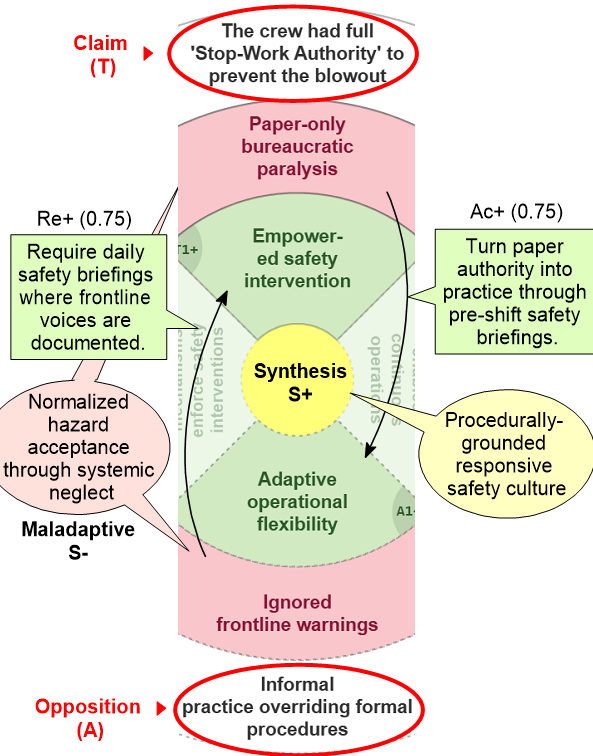
T+ (Upside): Safety intervention
T− (Downside): Bureaucratic paralysis
A+ (Upside): Operational flexibility
A− (Downside): Ignored warnings
Synthesis space (S+):
Ac+ (T- → A+) = Pre-shift safety briefings
Re+ (A- → T+) = Document frontline voices
| One-sided (T+) Optimization | Dialectical (S+) Optimization |
| Mandate absolute “Stop-Work Authority” as a non-negotiable rule on paper | Implement pre-shift briefings where anyone can voice concerns, with documented outcomes |
Dialectical (S+) optimization redirects analysis from merely verifying formal safety rules toward evaluating the systemic conditions under which they fail, including hierarchical suppression of weak signals and the mismatch between official procedures and operational reality (Antonsen, 2009; Vaughan, 1996).
Conclusion: If fact-checking remains limited to verifying formal claims while excluding broader systemic counterforces, it risks reinforcing organizational narratives that mask catastrophic failure.
What’s Next: Forensic Dialectics
Refocus from a binary “True/False” verdict toward an analysis of the constructive and destructive potentials, as exemplified in our Generative Rules for Synthesis Prediction.
This opens a new category of risk mitigation, helping individuals and organizations to plan their future independently of whether a given fact is true or false. The goal is to design path forward rather than to determine ‘who is right’.
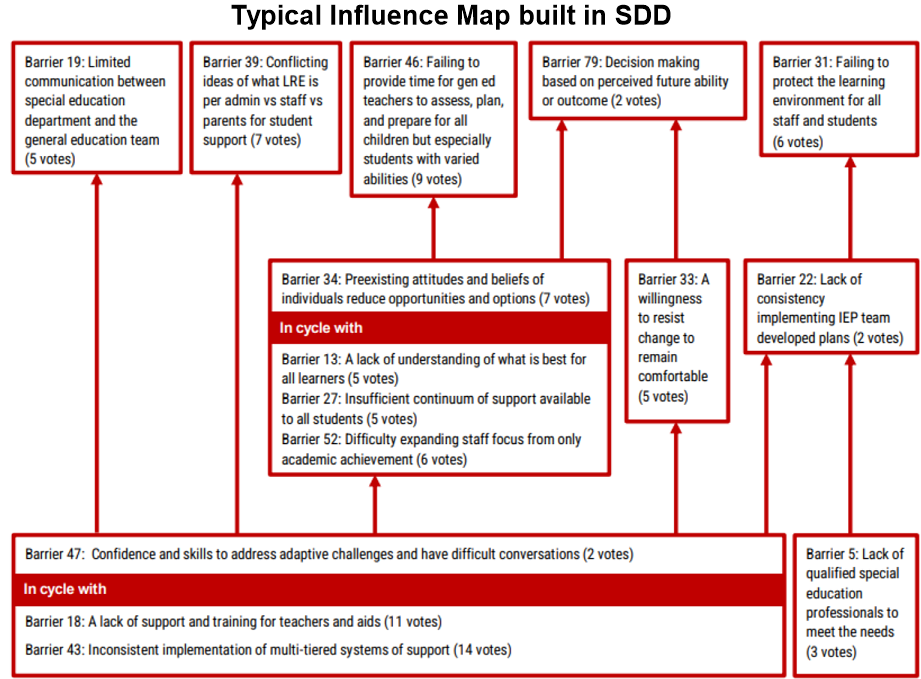
Any disagreements can be resolved via SDD influence mapping (illustrated on the right)—redirecting static confrontation toward collaborative systems insight. Rather than debating isolated facts, SDD maps the interrelations and root causes underlying the conflict, similarly to how dialectical analysis shifts attention from a fact to its relation with the antithetical domain.
Thus, collaborating with SDD professionals (e.g., Futureworks and 21st Century Agoras) or dedicated management consultants (e.g., Polarity Partners) could help fact-checkers evolve from policing the past toward designing more resilient futures.