


Sometimes an unassuming book can quietly change a lot. Such book is: The Thread: Within the Deliberative Democracy Labyrinth by Alexander N. Christakis and Maria Z. Kakoulaki.
It shows how collective decisions can be made to work under complexity—and, by contrast, why they so often fail.
Before discussing the book, a more basic question needs to be revisited:
1. Why Majority Decisions Fail?
Democracy is two wolves and a sheep voting on what’s for dinner.
Liberty is a well armed sheep protesting the vote.
We are taught that democracy works through public discussion and voting. Yet, both can be manipulated via multiple layers of groupthink bias:
- Asch conformity experiments: many people publicly endorse falsehoods under social pressure.
- Milgram obedience experiments: ordinary people comply with perceived authority even when this leads them to harm others.
- Naïve realism (Ross & Ward): people treat their own view as objective and dismiss disagreement as bias or ignorance.
This is why truth cannot be decided by majority vote. No parliament can vote to prove a mathematical theorem—and likewise, it cannot determine what is genuinely good or bad for people by simply counting votes.
(For more arguments, see Why the majority is always wrong and List of Cognitive biases)
2. Mechanisms vs. Meaning
In response to failure, groups often turn to mechanistic fixes such as anonymization or procedural mediation. While these can curb overt dominance, they rarely resolve underlying value conflicts. In practice, procedures may regulate participation without producing shared meaning. I witnessed this firsthand in Lithuania’s National Forest Agreement: despite professional facilitation, dialogue became performative because the core priorities remained antagonistic.
A different path begins by recognizing that complexity cannot be outsourced to mechanisms. Rather than starting with values or positions, SDD begins with structured idea generation and relational mapping, through which shared meaning—and implicit values—emerge without debate:
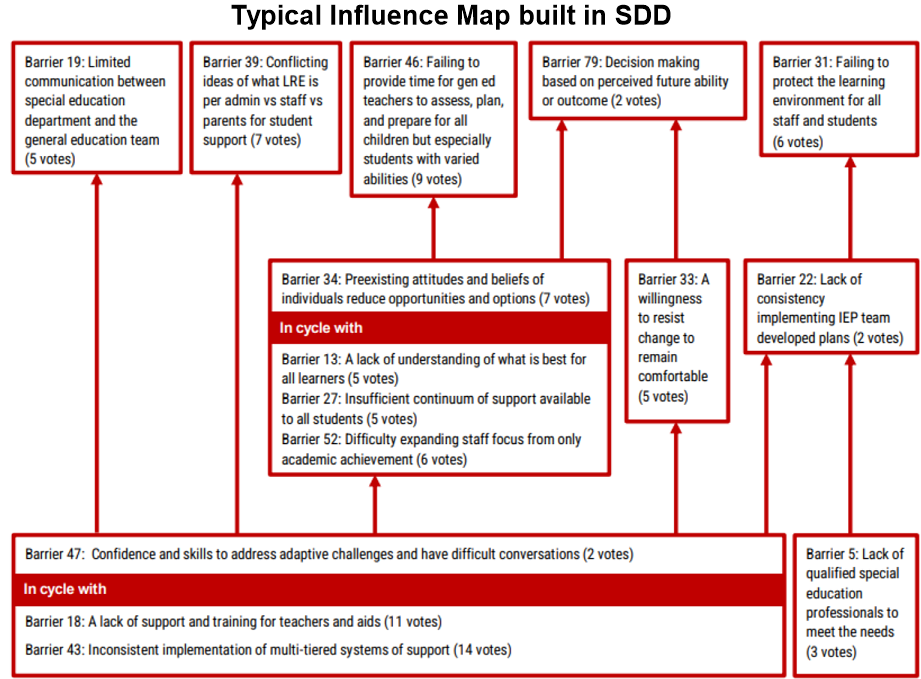
An illustrative influence map (an output of SDD/Logosofia approach)
showing how initially disconnected concerns become structurally related.
Through this process, groups come to see what actually matters once concerns are made explicit and related, which values persist beyond status and incentives, and how opposing perspectives constrain and complement one another within a shared system.
This shift—from negotiating positions to jointly structuring meaning and ideation—is where Structured Dialogic Design (SDD) enters.
3. What Is SDD?
Most people are not trained to think systemically under disagreement. Premature certainty, theoretical shortcuts, and adversarial framing quickly collapse dialogue into positions and power struggles.
Structured Dialogic Design (SDD) is a disciplined design process that enables groups to think together about complex problems before attempting solutions. In practice, it:
- ensures every perspective is heard and explicitly recorded,
- prioritizes ideas and reveals leverage points via influence maps,
- supports process with special software (CogniScope, Logosofia),
- gradually builds shared understanding and common ownership of the problem.
Unlike debate or parliamentary discussion, SDD replaces “either–or” thinking with “both–and” development. The aim is not winning, but collective maturation—the ability of a group to hold complexity without collapsing into simplifications.
The resulting solutions are multi-thetical: participants recognize their own concerns reflected in the outcome, even when no single position prevails (See 7Letter SDD Resources)
4. Contextual Perspective
The book situates SDD within a historical atmosphere that is difficult to reconstruct today. Its origins lie in the late 1960s and early 1970s—a period of civic experimentation, grassroots movements, and a search for new forms of collective sense-making. Christakis was originally trained in theoretical nuclear physics under John Wheeler—one of the most influential physicists of the twentieth century and mentor to Richard Feynman—before redirecting his work toward human systems.
A central contemporary of this work was Hasan Özbekhan, author of The Predicament of Mankind (1970) and the first president of the Club of Rome. The early Club of Rome envisioned global problem-solving as a deeply human, participatory endeavor. This orientation was later displaced by elite adoption of top-down, model-driven approaches (see the 7-minute video The Club of Rome’s Fork in the Road).
Christakis and Özbekhan did not accept this turn and stepped away. The dialogic path continued independently, while the modeling path became institutionalized—later finding expression in venues such as the modern Davos Forum.
The Thread does not polemicize against this history. Instead, it documents the development of SDD as a counterbalancing capacity: a structured way to reintroduce human judgment, collective ownership, and value-sensitive dialogue into decision-making environments dominated by reductionist logic.
5. What Comes Next: Toward Synthesis
The book is both a record of what has been built—and an invitation to continue the work.
We are entering a period of heightened social turbulence—marked by polarization, institutional distrust, and accelerating complexity—where neither technocratic control nor populist reaction has proved sufficient.
Yet, history does not stop at extremes—it spirals toward integration. The next step is synthesis between top-down systemic intelligence and bottom-up collective ownership:
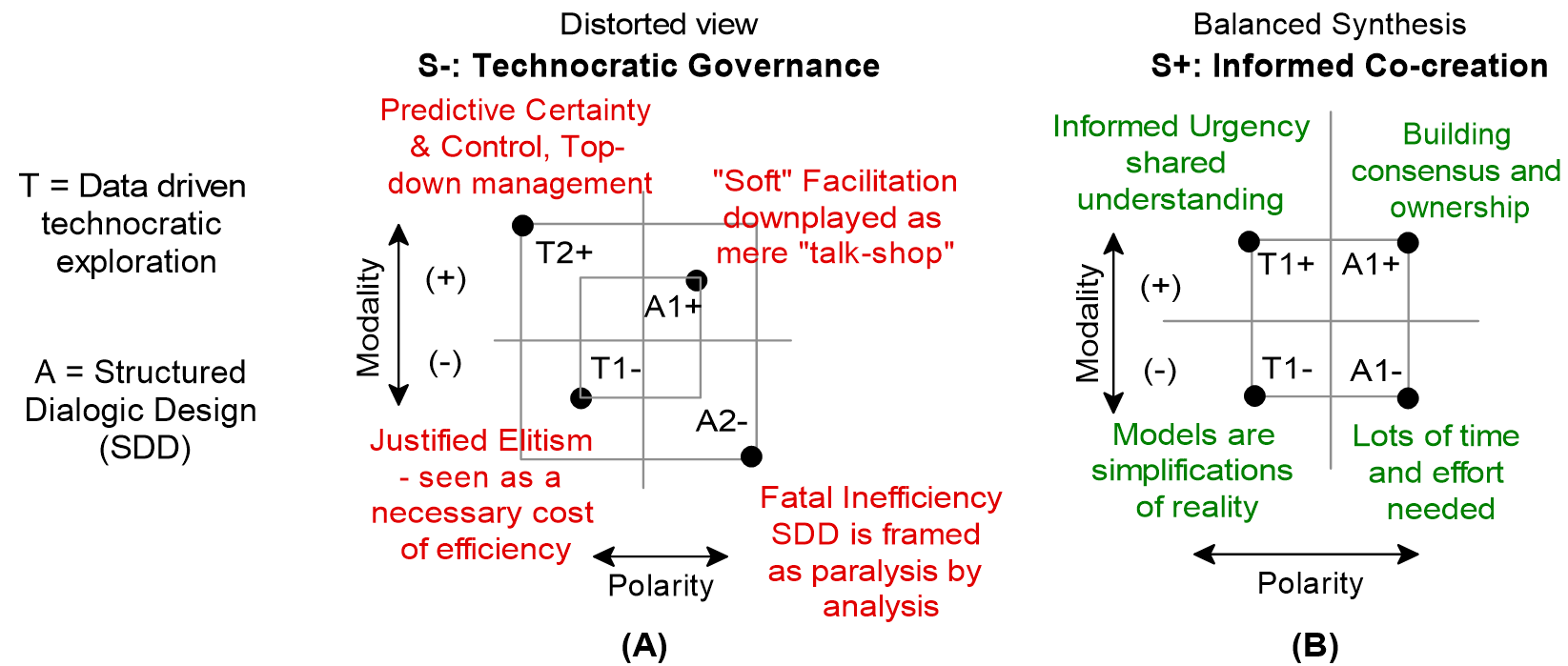
Two types of outcomes: (A) Technocratic, (B) Co-creative
SDD already provides the bottom-up human infrastructure for collective ownership and sense-making. What remains is its integration with top-down forms of systemic intelligence that enhance dialogic legitimacy. Early steps in this direction include integration with frameworks such as Logosofia (7 Letters) and the broader field of Dialogic Design Science.
Further extensions point toward a new class of diagnostics that explicitly support synthesis by preserving constructive diversity under pressure, including:
- Dialectical blind spots
- Manipulation and synthesis conditions
- Leadership capacity
(to maintain constructive diversity) - Organizational potential
(to develop resilience or fail despite of metrics) - Governance balance
(central coordination vs. participatory ownership)
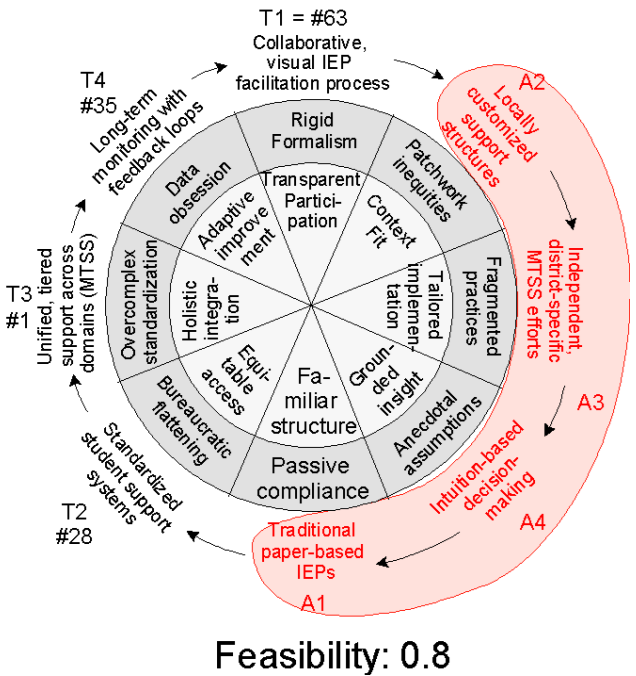
The Thread does not offer a finished system; it offers a demonstrated way of collective thinking under complexity. For readers who believe the future will require not only smarter tools but wiser collective judgment, this book stands as both a foundation—and a responsibility.