

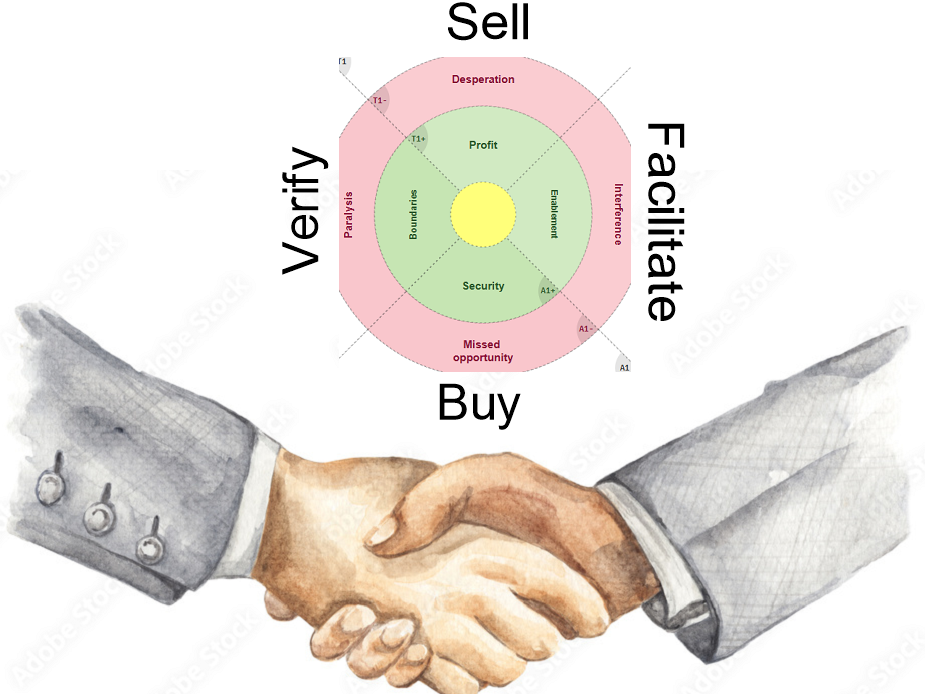
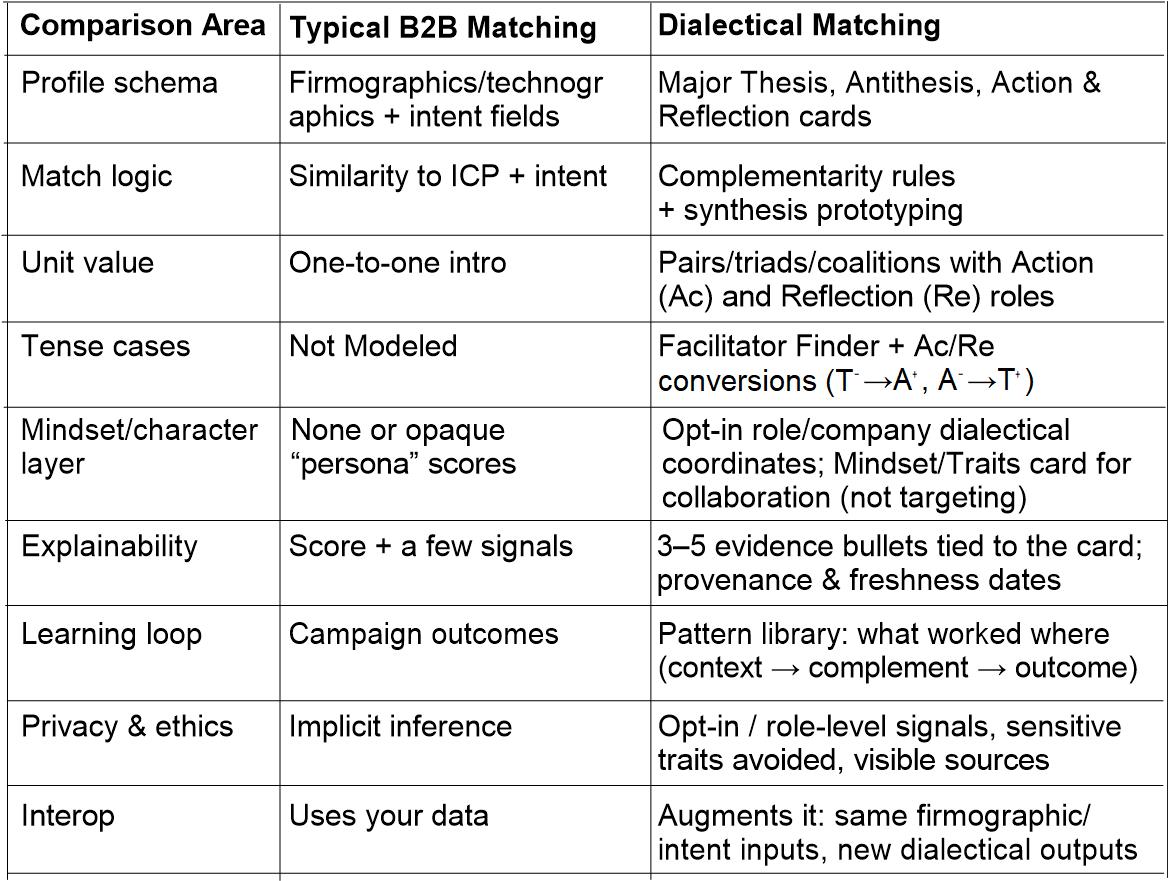
Most B2B platforms rank look-alikes against an Ideal Customer Profile (ICP) using firmographics, keywords, and short-term intent. We suggest a structured dialectics layer that models long-term complementarity (who makes whom better), conflict handling, and coalition or dream-team making.
Dialectics, in plain language, treats every contact or organization as a thesis—a center of gravity with strengths and over-rotations—paired with an antithesis—the constructive counterforce that, if engaged well, leads to synthesis. Add a second, orthogonal axis (action ↔ reflection—transforming one side’s negatives into the other’s positives), and you get a practical map for who should meet whom, and why.
Large contact databases stop being just directories and start becoming composition engines. A light, structured-dialectics layer explains, de-risks, and unlocks matches competitors miss. That’s good for revenue—and for ethics.
The problem with “just leads”
Most databases are rich in titles, tech stacks, funding, and intent signals—great for targeting—but weak at complementarity: who would actually improve each other. Profiles are also sparse and noisy; treating them like precise personality maps is risky, so we need robust, explainable features that tolerate gaps. And in tense cases, deals stall on misaligned expectations, governance worries, or team friction—standard scoring can’t suggest the right facilitator or partner to unlock progress.
What a dialectics layer adds
1. Build an explainable profile (per contact/company)
Thesis (T): what they emphasize (mission, OKRs, product story).
Antithesis (A): the constructive counter-role they need (obligations, guardrails).
Positives vs. negatives: T⁺/A⁺ (virtues to amplify) and T⁻/A⁻ (over-rotations to avoid).
Derived from public artifacts you already ingest (bios, posts, job ads, release notes)—with confidence scores and citations to evidence snippets.
2. Apply complementarity rules (that survive sparse data)
Match when T₁ ≈ A⁺₂ and T₂ ≈ A⁺₁ (each side’s strength fits the other’s constructive need).
Avoid when T₁ ≈ A⁻₂ or T₂ ≈ A⁻₁; also avoid when T⁻₁ = A⁻₂ or T⁻₂ = A⁻₁ (over-rotations hit the other’s threat).
Assign larger weights if the ± pattern matches a known complementarity/synthesis prototype (S⁺); reduce weights if it resembles a dominance pattern (S⁻).
For complex cases, assign Ac (Action) to convert T⁻₁/T⁻₂ → A⁺₂/A⁺₁, and assign Re (Reflection) to convert A⁻₁ → T⁺₁ and A⁻₂ → T⁺₂.
3. Run thesis-conditioned matching (query by thesis)
Context isn’t a static scenario; it’s the current thesis you’re testing. Pin client X’s thesis (T*_X) and re-rank the network relative to it: surface contacts whose A⁺ complements T*_X, down-rank those whose A− would resist it, and suggest Ac/Re helpers to convert T− → A⁺ and A− → T⁺ where needed. Under the hood, keep a stable base card for everyone and compute this thesis-conditioned view on demand.
4. Optional, opt-in mindset/character layer (role-level, evidence-backed)
When consent and enough public text exist, the same dialectical coordinates can support Mindset Mapping, Character Profiling, and Emotion’s Tuning—at the role/company level (not personal beliefs) and with evidence + last-seen. The idea: infer coarse T/A themes and their ± over-rotations from what people publish (posts, docs), then surface strengths to amplify and risks to guard. Use this only to improve collaboration (e.g., facilitator picks, team rituals), not for cold outreach or sensitive inferences. See how dialectical coordinates help uncovering the inner strengths and weaknesses based on what you say or write.
What this unlocks
1. Facilitator Finder
Given a stalled negotiation or tense stakeholder mix, detect where each side is over-rotated (T⁻) and what they perceive as threat (A⁻). Then recommend a facilitator whose T accelerates the emergence of the missing A⁺, and score the fit by sector credibility, neutrality (no conflicts), timezone/language, and warm paths in the graph.
2. Blind-Spot Reports for key accounts
Given a prospect’s policy/OKR text or product narrative, produce a one-slide wheel that says, “Your thesis is Speed; the constructive counter is Quality Assurance; likely blind spots: Control debt and on-call burnout” (see OKR and Policy enhancement examples). Then suggest partners or advisors who carry the missing A⁺ capabilities.
3. Complex Deal Design
Vendor offers T₁ that satisfies A⁺₂; Buyer offers T₂ that satisfies A⁺₁ (each side’s thesis meets the other’s constructive need). An SI Partner (a services firm like Accenture, or a single Advocate/Facilitator) provides Action/Reflection by converting over-rotations: T⁻₁ → A⁺₂ and T⁻₂ → A⁺₁. If only one conversion is covered, add a counter-advocate or second facilitator to restore symmetry. This works from large M&A and industrial projects down to small roundtables (e.g., vendor PM + buyer lead + independent advocate): the advocate designs lightweight proofs/guardrails and decision rituals so both sides’ positives can synthesize.
4. Compose Dream Teams
Use the same rules to assemble small, high-leverage squads. Pair an Innovator (T) with a Business/PR lead (A⁺); add Ac to turn T− → A⁺ (lightweight ops/PM guardrails) and Re to turn A− → T⁺ (coach/tutor that converts doubts into decision rules).
Optional mindset layer: with opt-in data, include a simple working-style card (e.g., DISC/Big-Five analogs derived from public text) to improve handoffs and rituals—used for collaboration, not targeting.
How to compute
Signals you already have → dialectical features:
- Job posts & tech stack → implied needs (candidate A⁺ roles).
- Roadmaps, release notes → thesis themes (T).
- Support/review snippets → recurring counterforces (A).
- Titles & seniority → authority/budget/timing (gating, not dialectics).
- Geography & language → compatibility filters.
Scoring sketch (added to your existing lead score):
dialectic_score =
  + α · 1[T(1) ≈ A⁺(2)]
  + α · 1[T(2) ≈ A⁺(1)]
  - β · 1[T(1) ≈ A⁻(2) or T(2) ≈ A⁻(1)]
  + γ · 1[orthogonal Action/Reflection support present]
Multiply each indicator by its confidence and decay stale evidence. Always keep hard gates for risk/compliance and interop.
What you can promise
- More useful intros (“why this match” in 3 bullets).
- Better outcomes in tense cases via facilitator matching.
- Investor-friendly explainability: a tasteful visualization of strengths, counterforces, and proposed complements.
Position it as an ethical advantage: you’re not just extracting value from contacts—you’re building conditions for mutual benefit.
Getting started
- Template the profile. Add
thesis,antithesis,T_plus,A_plus,T_minus,A_minusfields to your contact/company schema with evidence links and confidence. - Backfill with safe NLP. Mine public text for a small, domain-specific label set (e.g., Speed, Safety, Cost, Trust, Interop, Compliance).
- Ship two workflows first.
- Blind-Spot Report (for outbound and QBRs).
- Facilitator Finder (for late-stage or red accounts).
- Close the loop. Add simple feedback buttons: Relevant / Not now / Wrong read. Retrain monthly.