

1. The Problem We Solve
Most projects and policies fail because we see only part of the picture. Objectives become exaggerated, opposing views demonized, and quick fixes win over deeper solutions.
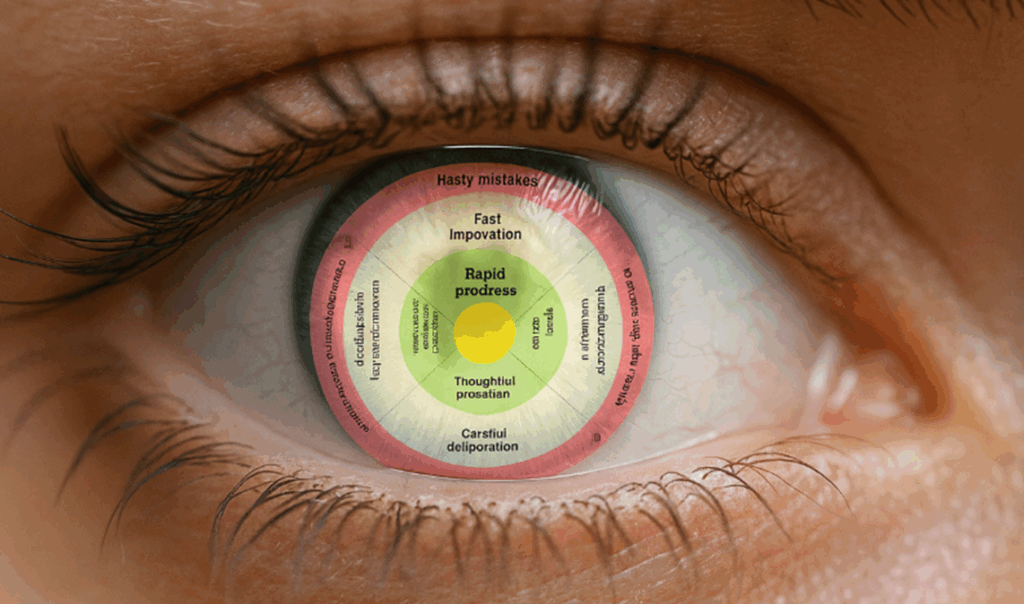
Eye Opener applies Structured Dialectics to reveal blind spots and win-win conditions often overlooked in the rush for fast results. In Daniel Kahneman’s terms, it promotes “slower thinking” helping managers, facilitators, and consultants uncover the positive aspects of opposition and design stronger future scenarios.
2. What Eye Opener Does
- Takes one or several statements (objectives, policies, principles, stakeholder positions).
- Automatically builds dialectical wheels / polarity maps:
- Shows positive and negative sides of each position.
- Reveals where exaggerated positions turn harmful.
- Suggests constructive (“positive synthesis”) and deceptive (“negative synthesis”) outcomes.
- Generates scenarios with feasibility scores to identify promising starting points.
Think of it as a “map” for navigating tough trade-offs.
3. Who Uses It
- Project managers who must balance speed vs. safety, cost vs. quality, centralization vs. autonomy
- Consultants & facilitators who guide groups past deadlocks, or map complex stakeholder positions
- Corporate strategy teams and their advisers — consultants to top decision-makers who need to surface hidden trade-offs and model multiple futures before committing
- Policy planners who must regulate or reform without crushing opposition
- Coaches / educators who want to teach critical thinking, polarity management, or systems thinking.
4. Typical Use Cases
- Turning OKRs into decision maps – showing hidden trade-offs between targets.
- Turning policies into growth maps – when regulations become overbearing, Eye Opener reveals how to rebalance.
- Negotiating terms & conditions – see both your own and your counterpart’s principles and risks.
- Conflict mapping – as in our Israel–Palestine example: visualizing positions, risks, and possible constructive scenarios.
- Countering overreach or neglect – when teams exaggerate or ignore important signals.
- Teaching systems thinking – from simple word like “Fish” to global issues, showing how any concept has wider meaning.
5. Our Roots
Structured Dialectics draws on Lao Tzu, Heraclitus, Socrates, Aristotle, Zeno, Stoicism, Kant, Hegel and modern polarity management (presentation)
Core principle: any idea is good only as long as it still fosters the positive side of its opposite (Dialectical Ethics)
Eye Opener makes this visible, practical, and actionable (poster)
6. Brand Voice / Content Direction for LinkedIn
- Mini case studies (like our Israel–Palestine demo) showing the app on real or fictional conflicts.
- “Mind-widening” examples (e.g., “Fish” → nourishment of the world) to break consumerist framing.
- How-to posts on turning objectives or policies into maps.
- Quotes from experts (e.g. Quotes About Conflicts or Think Against Yourself)).
- Short explainer videos (30–60s) showing before/after maps.
- Calls to action inviting consultants, facilitators, and project managers to try the beta and co-develop scenarios.
7. Why People Will Pay
Eye Opener gives consultants, facilitators, and managers a repeatable framework to:
- Visualize and explain contradictions to clients.
- Reveal hidden risks and opportunities.
- Support more balanced, credible recommendations.
It turns “complex stakeholder politics” into clear, shareable visuals in minutes — a value-add they can bill for.
See Also:
- Try It Now
- How AI Can Cut Blind Spots in Half
- See the Bigger Picture / Demo
- Israel Palestine Assessment Demo
- Turn Policies into Growth Maps
- Turn Objectives into Action Maps
- ISSS 2025 Oral Presentation Slides
- ISSS 2025 Poster 1 – Cumulative Systems Optimization
- ISSS 2025 Poster 2 – SDD + Dialectical AI
- ISSS 2025 Poster 3 – Structured Dialectics
- Extended Abstract + Manuscript
- Wisdom Mining Protocol
- Dialectical Ethics
- Moral Wisdom from Dialectics