

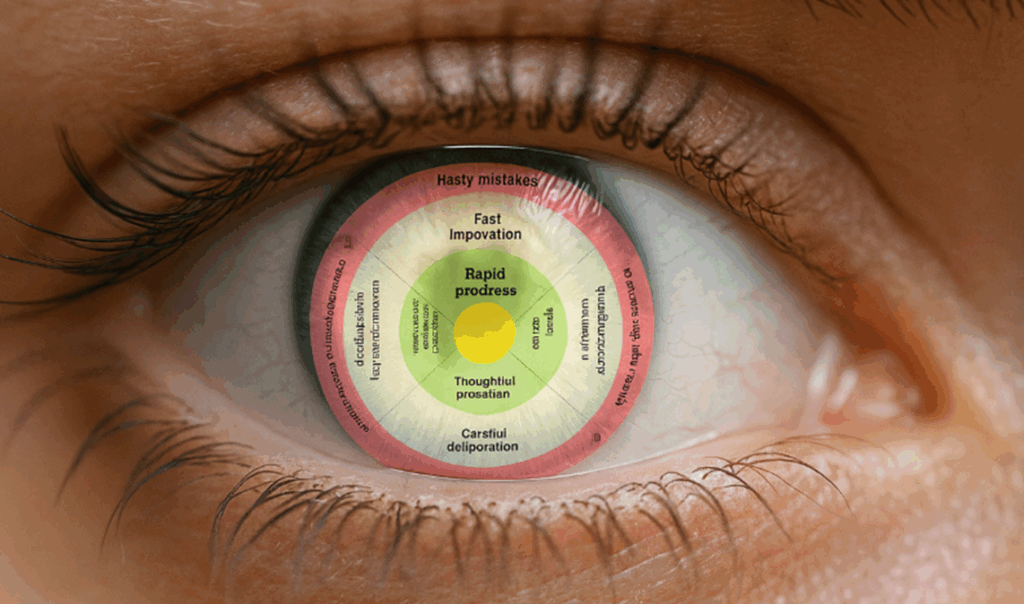
“It ain’t what you don’t know that gets you into trouble. It’s what you know for sure that just ain’t so.” — Mark Twain
1. The Problem We Solve
Systems thinking begins where certainty breaks
Most projects and policies fail because we fall into binary thinking. When we “know for sure” that our objective is right, we naturally:
- Exaggerate the Upsides: Blindly scaling one virtue until it becomes a vice.
- Demonize the Opposition: Seeing it as an obstacle rather than a source of growth.
This turns us into cynical consumers of ideas—exterminating each other’s values in the pursuit of narrow-scale perfection.
Eye Opener uses Structured Dialectics to break this loop, revealing the blind spots and win-win conditions that are usually sacrificed in the rush for fast results.
2. What Eye Opener Does
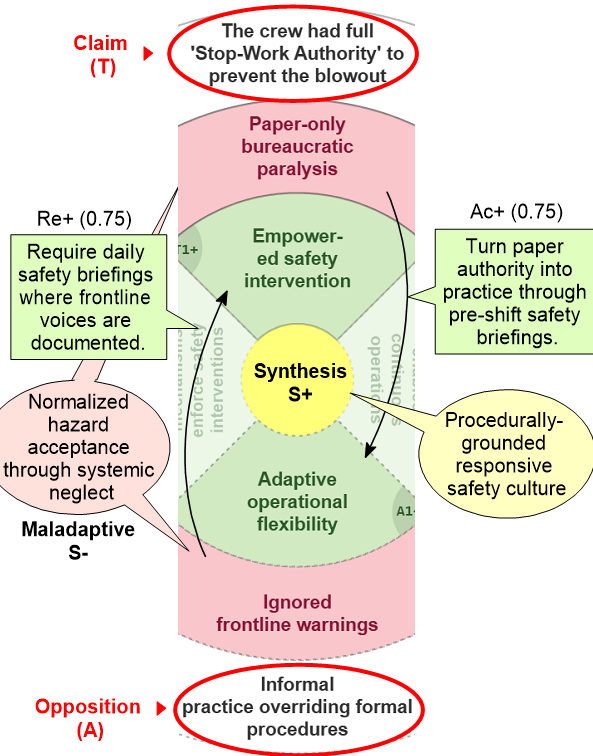
- Takes one or several statements (objectives, policies, principles, stakeholder positions).
- Automatically builds dialectical maps:
- Follows Rigorous Rules to minimize bias.
- Suggests apex antitheses as critical blind-spots.
- Interrelates upsides and downsides of oppositions to achieve balance.
- Suggests synthesis outcomes & maladaptive traps.
- Generates a Transitions Matrix (“if – then” transformations) for converting downsides into upsides.
3. Use Cases
- Conflict Resolution, Facilitation, SDD:
- Safety & Risk specialists – to deconstruct high-stakes failures, build resilient systems:
- Global Politics:
- Business – corporate structure and strategy alignment:
- OKR harmonization & Mission Harmonization,
- Avoiding The Optimization Trap
- Blind-spot Identification & General Considerations
- Leadership auditing – Uncovering the “Hidden Architecture”
- Management diagnostics – Top-Down/Bottom-Up harmonization
- Policy Creators & Regulators:
- Truth, Ethics & Narrative Guardians
- Fact-Checkers: Turn Judging into Auditing
- Ideologists: Ideological Distortions, False Certainty, Intelligence vs Ignorance, AI Dilemma
- Ethicists: Redefining Good and Bad, Seven Social Sins, When Right is Bad and Wrong is Good, Dialectical Ethics
- Editors & Influencers: Identify Exaggerations
- Developmental & Cognitive Specialists
- Educators: Visualize Systems Thinking
- Psychologists: Blind-Spot Identification, Two Paths to Compromise
4. Our Roots
- A 2,500-Year Foundation: Structured Dialectics bridges ancient wisdom with modern systems science—integrating the insights of Lao Tzu, Heraclitus, Socrates, and Stoicism with the formal logic of Kant, Hegel, and modern Polarity Management (see Intro and Presentation)
- The Golden Rule of Ethics: Our core principle is that any idea remains “good” only as long as it fosters the positive side of its opposite. When an idea loses this balance, it becomes a “blind-spot” that triggers system failure (see Dialectical Ethics)
- Engineered “Slower Thinking”: In Daniel Kahneman’s terms, Eye Opener serves as an external cognitive architecture that promotes “System 2″ thinking. It forces managers, facilitators, and consultants to look past the “obvious” and uncover the hidden value in opposition.
- From Philosophy to Practice: Eye Opener makes these tensions visible, measurable, and actionable (see the poster).